
Real-Money Casino Table Games in Australia: Legal Guide
 Available in AU
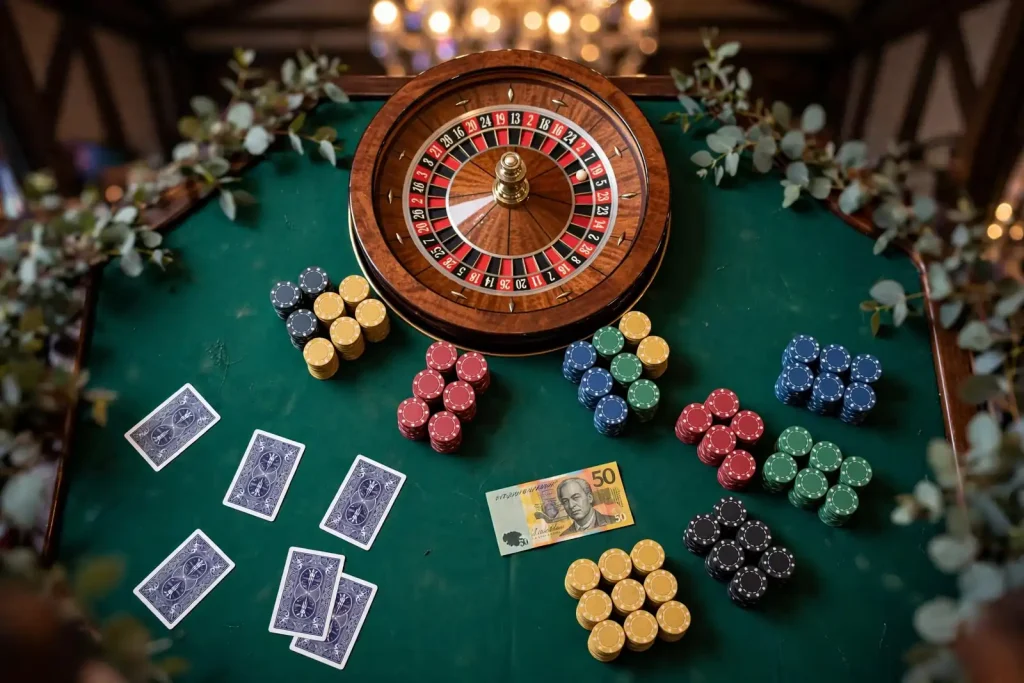
The guide distinguishes Australia’s online casino restrictions from payment choices, odds evidence and the rules of familiar table games.
Table of Contents
- The Legal Boundary Around Online Table Games
- Bitcoin at the Table: A Payment Question, Not a Game Rule
- What the Available Facts Can—and Cannot—Say About Table-Game Odds
- The Contest at the Table: Hands, Dealers and Dice
- The Search for a Nearby Casino Has No Verified Answer Here
- What Makes a Table Game a Table Game?
- Live Tables and the Familiar Forms of Roulette
- Card Tables: Where the Bet Can Land
- Roulette Rules Without a Promise of Free Play
- Poker at the Casino Table
- Games &
The Legal Boundary Around Online Table Games
In Australia, the legal question comes before the question of which table game appears on a screen. The Interactive Gambling Act 2001 prohibits operators from providing real-money online casino games to people physically located in the country. Blackjack, roulette, poker and other casino-style games fall within that boundary. The restriction concerns the service offered to customers in Australia, not merely the location of a server or the wording on a website.
Section 5 of the Act is part of the framework barring Australian-based operators from offering real-money interactive casino games to residents. The Australian Communications and Media Authority (ACMA) oversees compliance and can take enforcement action, including blocking access to unlicensed services. In practical terms, offshore branding does not turn an online casino into a lawful Australian service. Nor does the fact that a site can be reached at a particular moment establish that it is permitted to provide the activity.
The distinction matters because online access can be mistaken for legal approval. A website may present familiar table-game formats, payment options and promotional language, but those features do not change the prohibition on providing the service to people in Australia. The Act places the central legal burden on operators: the relevant conduct is supplying prohibited interactive gambling services to customers here. The law is not an invitation to treat offshore access as an approved alternative.
That boundary also changes how promotional claims should be read. A bonus is not simply an amount added to a balance; its terms can tie the funds, and any winnings associated with them, to wagering conditions. Those conditions are separate from the lawfulness of the service itself. A promotion cannot create an exception to the Act.
The arithmetic beneath a bonus
A specialist review illustrates the mechanics with a hypothetical A$100 bonus carrying a 30-times wagering requirement: the stated requirement would translate into A$3,000 in total bets before a withdrawal could be made. That example explains how the multiplication works; it is not a current offer or a recommendation. The number attached to any real promotion depends on its own terms, and an advertised bonus should not be mistaken for immediately withdrawable money.
Games & Apps: Casino Options in Australia · Online Pokies with E-Wallets in Australia
The calculation is only one part of the condition. Terms may assign different contribution rates to different game categories, so a bet on a table game may advance a wagering requirement more slowly than a bet on another category, or may not qualify at all. A specialist review describes slots as counting fully in some terms while blackjack and roulette may receive a smaller contribution, with some games excluded. These are descriptions of terms reported by that kind of review, not a universal rule for Australian services—and they do not make the underlying online casino offer lawful.
For a table-game bet to count, the promotion’s game-contribution table is the relevant detail. A headline wagering multiple alone cannot show how much qualifying play is required in practice. If a game contributes only a fraction of the stake, the balance does not advance as quickly as the raw bet total might suggest. If a title is excluded, play on it does not clear the requirement. The conditions can therefore make a nominally simple bonus more restrictive for table-game play.
International Casinos for Australian Players: 2026 Guide
Other clauses can also determine whether promotional funds remain eligible. A maximum bet during wagering, exclusions, expiry conditions and rules about which balance is used may all affect the outcome. Their presence and wording depend on the terms in question; there is no single table-game contribution schedule to assume. Promotions are contracts in miniature, and the small print does much of the governing.
This is why bonus language should be kept separate from claims about access. A site’s offer may describe what its own terms require, but it cannot certify that the service is lawful in Australia. Likewise, a game’s eligibility under a bonus says nothing about whether the operator may provide real-money casino play to someone physically in the country. Two distinct questions, often packed into one bright banner.
The legal framework is not a variation in table-game rules. It is the outer limit around the activity: Australian law prohibits the provision of real-money online casino games to customers in Australia, and ACMA enforces the regime. Promotional terms then govern how an offer is calculated within the operator’s own conditions; they do not move that boundary. The distinction is plain. The consequences are not.
Legal Prohibition
The Interactive Gambling Act 2001 prohibits operators from providing real-money online casino games to people physically located in Australia.
Bitcoin at the Table: A Payment Question, Not a Game Rule
The phrase “Bitcoin table games” joins two different questions. One concerns how a payment is made; the other concerns what happens at a game table. Putting them side by side in a label does not make them the same thing. A payment method is not a rule, a hand, a wheel or a wager’s outcome.
That distinction can be easy to lose in casino language, where the payment option and the game catalogue may appear on the same screen. Yet they belong to separate parts of the arrangement. Table-game rules describe the choices and outcomes that structure play. A payment method concerns the movement of money around that activity. Neither category explains the other.
Bitcoin, as a payment method, does not by itself define how a table game is played. Nor does the name of a game establish which payment methods a particular service accepts. A claim about one cannot safely be inferred from the other. The distinction is plain, if not especially glamorous.
This is why comparisons between Bitcoin table games and “normal” table games can mislead. The wording suggests that the games themselves differ because the payment method does. But a payment label alone says nothing about the game’s rules or the way its outcomes are determined. To compare games, the relevant questions concern their mechanics; to compare payment arrangements, the subject is the payment arrangement. Mixing the two produces a category error dressed as a product comparison.
Real Money Pokies on Android in Australia: Legal Guide · Casino Apps in Australia: What “App” Really Means
The same separation applies to requests for the “best” Bitcoin casino table games. “Best” needs a measure: it might mean a preferred style of play, particular rules, or some other clearly stated feature. Bitcoin does not supply that measure. It names a payment method, not a standard for judging table games. Without a defined basis for comparison, a ranking would say more about the wording of the label than about the games.
There is a social history in this habit of bundling. Modern commerce tends to present a service as one seamless object: the table, the cashier, the interface, the promise of access. But these are different arrangements gathered under one roof, and their proximity can make a payment option seem like part of a game’s identity. It is not. The rules of a table game are not rewritten by the name attached to a payment method.
“Casino table games for Bitcoin” therefore remains an imprecise description. It may refer to games associated with a service that accepts Bitcoin, rather than to a distinct class of games. The distinction matters because the first claim concerns a service’s payment arrangements, while the second would imply that the games themselves have some Bitcoin-specific form. Those are not interchangeable statements.
A top-table list has the same problem if its organising principle is merely the payment label. A table game might be discussed on its own terms, but a payment method cannot establish that it is superior, more suitable or more rewarding. Those judgments require criteria related to the games, not an association with a means of payment. The phrase “table top games” may sound like a ranking; the label alone does not make one.
Payment vs Rules
A payment method, such as Bitcoin, concerns the movement of money and does not define the rules, mechanics, or outcomes of a table game.
The careful vocabulary is less exciting and more useful: payment method on one side, game structure on the other. Bitcoin belongs to the first category. Table rules belong to the second. When those categories are blurred, a familiar game can be made to sound like a new product without any change to its play. A new label is not a new rule.
What the Available Facts Can—and Cannot—Say About Table-Game Odds
A search for the table games with the best odds sounds as though it should produce a tidy league table: favourable at one end, costly at the other. But “odds” can refer to different things. The chance of a particular result, the amount paid when it occurs and the house’s long-run mathematical advantage are related, not interchangeable. A ranking that treats them as one measure risks making a clear-looking chart out of unlike quantities.
The house edge is a way of describing the casino’s theoretical advantage across repeated play. It is not a prediction of what will happen in a particular session, nor a promise about the result of any one bet. A player can win or lose in the short term; the long-run calculation describes an average across a large volume of outcomes. That distinction matters. A game’s reputation for “good odds” cannot guarantee that an individual hand or spin will be favourable.
Real-Money Pokies in Australia: Apps and Browser Play
The calculation also depends on what is being compared. Different bets within a game can have different probabilities and payouts, so a single figure for the whole table may hide more than it reveals. Rules matter too: a change in a payout or in how a particular outcome is handled can change the underlying comparison. Any claim about the best odds at casino table games therefore needs to specify the wager, the applicable rules and the measure being used.
A house-edge chart is useful only when its entries share a basis. If one number describes a particular bet and another describes a game more broadly, lining them up does not make them comparable. The same goes for claims about the worst odds: “worst” has no stable meaning until the comparison is defined. Is it the lowest chance of winning a bet, the least favourable payout for a given chance, or the highest theoretical house advantage? Each question asks for a different calculation.
Return figures require similar care. A theoretical return is not a forecast of a session’s cash-out, and a percentage cannot sensibly be detached from the rules and wager it describes. It is a long-run measure, not a timetable. Statistics are patient; people at tables are not always so.
There is a further distinction between mechanics and mathematics. Knowing that a game pits a hand against a dealer, or that a bet concerns a possible outcome, explains the shape of play. It does not by itself establish the probability of each result or the value of each payout. Those details are what turn a general description into an odds comparison.
Attention A game’s theoretical house edge is a long-run mathematical average and not a prediction or guarantee of the result of any individual session or bet.
So a defensible answer to “what casino table games have the best odds?” is not simply the name of a familiar game. It requires comparable calculations tied to defined rules and bets. Without that groundwork, naming a winner—or a loser—would give confidence where the arithmetic has not earned it. The chart would look precise. That is not the same thing.
The Contest at the Table: Hands, Dealers and Dice
A table game is often organised around a contest: a player measures a hand against a dealer, wagers on which of several card outcomes will occur, or stakes a bet on the result of dice. The equipment differs, but so does the player’s place in the action. Sometimes the player is trying to produce a stronger result; sometimes the player is choosing which outcome to back. The distinction is more than cosmetic.
In Blackjack, the player’s hand is judged against the dealer’s. The aim is to finish with a value closer to 21 than the dealer’s hand. That gives the game a direct opponent, even though the contest is mediated by fixed rules rather than personal rivalry. The dealer is not simply another player at the table: the dealer supplies the comparison against which the player’s result is measured.
That arrangement has an old social logic. A contest needs an opposing side, and the dealer makes that side visible. The player’s attention stays on two hands and one target, rather than on a field of possible outcomes. The rules turn a private calculation into a public ritual: cards are dealt, values take shape, and the dealer’s hand provides the answer. Simple to describe; less simple to sit through.
Other card-table formats organise the wager differently. A player may bet on their own hand, the Banker’s hand, or a tie. Here the central decision is not solely how a hand compares with a dealer’s. It is which of the named outcomes will prevail. The structure gives the table several possible sides, and the wager identifies the one a participant has chosen to support.
Live Baccarat Online in Australia: Rules and Risks
That changes the feel of the contest. A bet on a hand is not the same as holding that hand, and the Banker’s position is not just another name for the dealer’s role in Blackjack. The important feature is the choice among outcomes. The table makes that choice legible before the result is known; afterwards, the result determines whether the selected outcome was correct. No elaborate story is required.
Dice move the focus from hands to a thrown pair. Players roll two dice and bet on the outcome. The physical action is brief and conspicuous: the dice leave the hand, strike the surface, and settle. The wager gives that moment its meaning. Unlike the hand-versus-dealer structure, the contest is not described as a comparison between two opponents; the bet attaches instead to what the roll produces.
Across these formats, the table is a small piece of social architecture. It assigns roles, narrows uncertainty into choices and makes a result visible to everyone present. A dealer can embody the opposing side; a named hand can become the object of a wager; a pair of dice can carry the whole event. These are different ways of arranging attention and risk, not interchangeable versions of one contest.
Blackjack
A player’s hand is judged against the dealer’s with the aim of finishing closer to a value of 21.
Outcome Betting
Wagers are placed on specific named results, such as the Player’s hand, the Banker’s hand, or a tie.
Dice Games
Players roll a pair of dice and bet on the outcome produced by the throw.
Understanding those arrangements is the useful first step in learning how such games are structured. It does not establish where they are available or make them lawful to offer in Australia. A game’s familiar form and the legal conditions around its provision are separate matters.
The Search for a Nearby Casino Has No Verified Answer Here
“Nearby” sounds like a simple measure of distance. In practice, it depends on where a person starts, how they can travel and which sort of venue they mean. A casino with table games is a physical destination; the phrase cannot be answered by describing an online game or a remote service. Without a specific starting point and confirmed venue details, there is no sound basis for naming the closest casino.
That distinction matters because place names in a search can point well beyond Australia. Miami and Ohio, for instance, are not Australian locations. Their appearance in a request does not establish anything about venues there, or make them useful answers for someone seeking a nearby Australian destination. Geography is stubborn that way.
Nor does the word “new” settle the matter. A recently opened venue, a newly introduced table game and a new result in a directory are different things. Each would require its own current details. The phrase alone cannot show that a casino has opened, that it offers table games, or that its location is convenient to any particular person.
Mines Casino Game in Australia: Search Guide
A useful local listing would need to connect several separate facts: the venue’s address, its operating status and whether table games are available there. Distance is only one part of the answer. A name without those details may look decisive while leaving the central question untouched. A map pin is not a table.
There is also a difference between finding a casino and establishing what kind of gambling service is being discussed. Australia’s Interactive Gambling Act 2001 prohibits operators from providing real-money online casino games to people physically in Australia; the Australian Communications and Media Authority enforces the rules, including by blocking unlicensed domestic platforms. That concerns online services, not a claim about the existence or location of a physical venue. The two settings should not be folded together merely because both involve casino table games.
A nearby-casino question therefore remains local in the strict sense: it needs a point of departure and dependable information about a physical place. General descriptions of blackjack, roulette or other table formats cannot supply either. And an answer naming a city overseas would not become local simply because the wording asks for the nearest casino.
The nearest casino is a fact about a person’s location and a venue’s current details, not a universal feature of a game. No map without a starting point.
What Makes a Table Game a Table Game?
Choosing a real-money casino for table games in Australia calls for checking the available licensing and payment details before deciding where to play. This list offers a concise reference to the information provided for each operator.
1. Playfina Casino
License: Curacao eGaming (Hollycorn N.V., since 2017) · Min. deposit: A$20-30 (depends on the offer) Playfina Casino is listed with a Curacao eGaming license held by Hollycorn N.V. since 2017. Its minimum deposit is A$20–30, depending on the offer.
2. DragonSlots Casino
License: Curacao Gaming Authority (Jumpman Gaming Ltd) DragonSlots Casino is listed with a Curacao Gaming Authority license held by Jumpman Gaming Ltd.
3. LevelUp Casino
License: Curacao eGaming OGL/2023/174/0082 (Dama N.V.) · Min. deposit: A$15 LevelUp Casino is listed with Curacao eGaming license OGL/2023/174/0082, held by Dama N.V. Its minimum deposit is A$15.
4. Bizzo Casino
License: Curacao Gaming Control Board (TechSolutions Group N.V.) Bizzo Casino is listed with a Curacao Gaming Control Board license held by TechSolutions Group N.V.
5. LuckyVibe
License: Curacao Gaming Control Board OGL/2023/176/0095 (Hollycorn N.V.) LuckyVibe is listed with Curacao Gaming Control Board license OGL/2023/176/0095, held by Hollycorn N.V.
6. Thor Casino
License: Curacao – Antillephone N.V. (Versus Odds B.V.) · Min. deposit: EUR 20 Thor Casino is listed with a Curacao license held by Antillephone N.V. for Versus Odds B.V. Its minimum deposit is EUR 20.
7. SpinsUp
License: Curacao Gaming Control Board OGL/2023/174/0082 (Dama N.V.) SpinsUp is listed with Curacao Gaming Control Board license OGL/2023/174/0082, held by Dama N.V.
8. SkyCrown
License: Tobique Gaming Commission · Payout speed: crypto ~10-15 minutes, fiat 1-5 days · Min. deposit: A$30 SkyCrown is listed with a Tobique Gaming Commission license and a minimum deposit of A$30. Stated payout times are around 10–15 minutes for crypto and 1–5 days for fiat.
9. MrPacho
Payout speed: crypto 30-120 minutes, fiat 24-72 hours · Min. deposit: A$30 MrPacho has a stated minimum deposit of A$30. Its stated payout times are 30–120 minutes for crypto and 24–72 hours for fiat.
10. Golden Pokies
License: Curacao Golden Pokies is listed with a Curacao license.
A casino table game is defined less by the shape of its furniture than by the kind of contest it stages. Cards, a wheel or dice may supply the action, but online the decisive distinction is how that action reaches the screen: through a live dealer and physical equipment, or through software that determines the outcome.
In a live-dealer format, an actual dealer operates real casino equipment. A video stream carries that activity to the people watching remotely. The table is therefore both a working surface and a small stage: the dealer’s gestures, the movement of the equipment and the unfolding round become part of what is seen. The technology transmits an event taking place elsewhere; it does not make the event itself.
That distinction matters because a streamed table and a digital table can look similar at a glance while relying on different processes. A live feed shows a dealer handling the game in real time. In an online version without a live dealer, a Random Number Generator (RNG) determines the relevant outcome. For a card game, it determines which cards are dealt; for roulette, where the ball lands. The screen presents the result, but the source of that result is software rather than a visible physical round.
Do
- Identify live dealer games by the presence of a video stream and physical equipment
- Recognise RNG games as software-determined outcomes
Don’t
- Assume the word “table” always implies a physical gathering or furniture
- Confuse a live stream for a physical presence around a felt table
The word “table” can obscure this difference. In a casino building, it suggests a place where people gather around a felt-covered surface, with a dealer and equipment at the centre. Online, the word may describe the game’s format even when no physical table is involved. A digital interface can preserve the recognisable structure of a table game without reproducing the room, the dealer or the shared bodily presence around the felt.
Nor does a live stream turn a remote game into a gathering in the ordinary sense. The people watching may be in separate places, connected to the same broadcast rather than seated around one table. What survives is the visible procedure: a dealer acts, equipment is used, and the video carries that sequence outward. In the RNG format, even that visible procedure may be represented by graphics rather than performed by a dealer on camera.
So “table game” is a broad category, not a promise of a particular setting. It can refer to a live event delivered by video or to a software-determined game presented in digital form. The difference is not merely decorative. One shows a real dealer using real casino equipment; the other relies on an RNG to produce the game outcome.
Crash Casino Games in Australia: How They Work
A table, then, may be a place, a broadcast or an interface. Same label; different machinery.
Live Tables and the Familiar Forms of Roulette
Roulette gives the casino table a particularly legible shape: a wheel, a field of numbered spaces and a ball whose final position settles the wager. Its names are familiar enough to sound like small variations on one custom. The distinction is in the wheel itself, and in how many marked outcomes it presents.
The principal online versions are European, French and American roulette. European and French wheels share the same stated layout: 36 numbered spaces and a green zero. American roulette has those numbered spaces and a green zero too, but adds a green double zero. That extra marking is the visible difference between the two broad layouts. A small alteration, plainly announced.
The green spaces matter because roulette is not simply a row of numbered choices. The zero—or, on the American wheel, the zero and double zero—sits apart from the numbered field in colour as well as name. The arrangement gives the wheel a boundary within its own set of outcomes. Nothing about the table’s familiar appearance makes those versions interchangeable.
European & French Roulette
These versions feature a wheel with 36 numbered spaces and a single green zero.
American Roulette
This version includes 36 numbered spaces, a green zero, and an additional green double zero.
French roulette belongs alongside European roulette in the principal group, and shares its stated count of numbered spaces and single green zero. The name may suggest a separate family to a casual observer; the layout information points instead to a close relation. A label can carry history, style or convention, but the distinction that can be read directly from these versions is the one on the wheel.
That is a useful way to approach any casino table games list: names are not enough when a game appears in several forms. Roulette’s variants are a compact example. The European and French versions have one green zero; the American version has two green markings, 0 and 00. The additional mark is easy to overlook in a glance at the table, yet it is precisely what separates the American layout from the other two described here.
The label “live” concerns the way a table is presented, not the roulette family’s numbering. Roulette can be encountered in discussions of live casino table games, but the wheel’s version is identified by its layout rather than by whether a dealer appears on screen. A live setting does not turn one numbered arrangement into another.
The rest is a matter of naming and presentation. The wheel keeps the record.
Card Tables: Where the Bet Can Land
Some card-table bets are placed not on a particular card, but on which of several named outcomes will prevail. The available choices are the player’s hand, the Banker’s hand, or a tie. That small menu changes the shape of the decision: the wager is attached to one side of the table’s contest, or to the possibility that neither side wins outright.
Online pokies Australia: real-money no-deposit offers
The labels sound almost administrative. “Player” and “Banker” identify the hands; they do not, by themselves, tell a story about who controls the game. The table turns those labels into destinations for a bet. A tie sits beside them as a third possibility, neither a side nor an afterthought, but an outcome that can be chosen in its own right.
That is the essential structure of this card-table wager. It is different from staking a bet on an individual card, and it need not be understood as a contest between every person seated at the table. The choice concerns the hands named on the layout. In that sense, the table organises uncertainty before play begins: three places for the wager to land, each expressed in plain language.
The distinction matters because “card games” is a broad family, not a single form of play. Some games centre on assembling a hand; others make the bet itself a selection among possible results. Here, the hand names do much of the explanatory work. The player’s hand, the Banker’s hand, and a tie are the available categories. No further account of dealing or scoring is needed to understand where a bet may be placed.
There is a quiet social history in such labels. A card table gives institutional names to opposing outcomes, then invites the room to treat those names as familiar. The Banker sounds like an office; the Player sounds like a role. Both become spaces on a betting surface. The terminology is more formal than the act it serves.
Card-Table Betting Options
In certain card games, bets are placed on one of three available categories:
- The Player’s hand
- The Banker’s hand
- A tie
The wager’s structure can be described without turning it into a promise about which choice is preferable. A bet on one hand is not the same selection as a bet on the other, and neither is the same as choosing a tie. What follows from each selection belongs to the rules of the particular game and its stated terms, not to the labels alone.
Three destinations. One table.
Roulette Rules Without a Promise of Free Play
Roulette’s rules begin with the wheel, whose layout differs by version. European and French roulette each have 36 numbered pockets and a green zero. The American wheel adds a second green pocket, marked 00, alongside its zero. That small extra marking changes the field on which bets are placed; it is not a decorative flourish.
The three familiar online versions are European, French and American roulette. Their names signal distinct wheel layouts, though European and French roulette share the same stated arrangement of numbered pockets and a single green zero. American roulette is recognisable by the additional green double-zero pocket.
Best Casino App for iPhone in Australia: A Guide
A table’s rules are easier to read when the wheel is treated as part of the game rather than as scenery. The numbered pockets and green markers define the outcomes the layout can produce. Before considering a bet, the relevant distinction is therefore which wheel is in use. A rule explained for one layout should not be assumed to describe another.
That is the useful limit of a brief comparison. The wheel variations identify the versions; they do not, by themselves, settle every question about a table’s betting conditions. Casino table games can share a name while presenting different arrangements, and roulette makes that difference visible in a single glance. One extra pocket is enough to make the label matter.
The word “free” often appears beside online games, but it does not describe a roulette wheel or establish how a particular table is offered. Nor does the existence of several versions imply that every operator makes each one available without charge. Roulette rules concern the wheel and the wagers attached to its outcomes; access and promotional terms are separate matters.
Australian Mobile Casinos: Sites, Apps and Offers
The same distinction applies to promotions and table-game rentals: neither changes the basic contrast between a single-zero wheel and an American wheel with both zero and double zero. The precise offer, if any, belongs to its own terms, not to roulette’s rules. Wheels are clearer than advertising.
Poker at the Casino Table
Poker turns a table into a contest among players: each tries to build the strongest possible hand. That objective gives the game its particular social shape. The opposing force is not simply a dealer’s target or a ball’s destination, but the other people seated around the same felt, each pursuing a better combination.
The hand becomes a small public drama. Players share a game, yet their aims diverge; every seat belongs to the same contest and none can claim the outcome in advance. Poker’s appeal lies partly in that tension between a common structure and competing ambitions. The table supplies the arena. The hands supply the argument.
Inclave Casinos in Australia: What Login Proves
The name “poker” covers a casino table-game category, not a promise that every version follows an identical format. The central idea remains the contest to make the best possible hand. That is enough to distinguish poker from card games organised around betting on a player’s hand, the Banker’s hand or a tie. Here, the players face one another through the strength of their hands.
The phrase “casino poker” can make the setting sound definitive, as if the table alone explains the game. It does not. Poker’s defining feature is the contest among players, rather than the furniture or the venue. A table gathers the rivals; the hand gives them a common measure.
There is also a limit to what that description can establish. It identifies poker’s objective, but does not specify the rules of every form, the ranking of particular hands or the details of a given table. Those belong to the rules of the version being played. The contest is the constant. The particulars vary.
Can you play table games online for real money?
No, real-money online casino games cannot lawfully be provided to people physically in Australia. A site being accessible does not mean its service is legally approved.
What is the legal status of online table games for Australian players in 2026?
Australian law prohibits operators from providing real-money online casino games, including table games, to people in Australia. ACMA oversees compliance and can take enforcement action.
Are online casinos legal in Australia?
Real-money online casino services cannot lawfully be provided to people physically in Australia. Offshore branding or access does not make a service an approved Australian offering.
Games &

Australian Mobile Casinos: Sites, Apps and Offers
A practical look at browser access, app shortcuts, payments, bonus conditions and the limits of...

Casino apps for Android in Australia: browser access
Learn how browser-based access, home-screen shortcuts and bonus terms shape casino use on Android. The...

Best Casino App for iPhone in Australia: A Guide
See how browser access, app listings, real-money play and free pokies differ on an iPhone...

Casino Apps in Australia: What “App” Really Means
The guide distinguishes browser sites, home-screen PWAs and downloads, then examines payments, bonuses, withdrawals and...

Instant Withdrawal Casinos in Australia: What to Check
“Instant” can describe only part of a payout: payment choice, verification and operator processing all...

International Casinos for Australian Players: 2026 Guide
A practical look at Australia’s legal line, mobile access, bonus conditions and the costs and...

Offshore Casinos for Australian Players: Assessing Claims
Browser-based play, legal limits, bonus conditions and payment routes affect what an offshore casino offers—and...

Casino Dice Games in Australia: Online Rules
The guide separates the mechanics and atmosphere of dice play from the legal limits on...

Crash Casino Games in Australia: How They Work
Crash games turn a rising multiplier into a cashout decision, but the visible pace of...

Inclave Casinos in Australia: What Login Proves
An Inclave sign-in may provide a route into an account, but it does not establish...

iPad Casinos in Australia: Legal and Practical Guide
The device does not change the rules: Australia prohibits operators from supplying online casino games...

Live Baccarat Online in Australia: Rules and Risks
Australia has no locally licensed online casinos, while international platforms may accept Australian players; this...

Live Blackjack at Online Casinos in Australia: Legal Limits
Australia’s rules distinguish familiar casino play from real-money online services, shaping what can be offered...

Live Roulette in Australia: Dealers and Legal Limits
The article explains Australia’s legal boundary and what the available evidence does—and does not—establish about...
Mines Casino Game in Australia: Search Guide
A guide to demos, bonuses, withdrawals and strategy claims in Australia's distinct pokies and online-gambling...

Online Pokies with E-Wallets in Australia
E-wallets handle deposits and withdrawals, while mobile casino play usually runs through a browser rather...

Plinko Casino in Australia: Games and Risks
A guide to how Plinko games are presented, what reviews can establish, and how payments,...

Online pokies Australia: real-money no-deposit offers
No-deposit labels do not establish legality or safety, and bonus play can come with wagering...

Real Money Pokies on Android in Australia: Legal Guide
Australian rules focus on the operator’s offer, while individual play is treated differently under the...

Real-Money Pokies in Australia: Apps and Browser Play
Many mobile casinos work through a browser, so understanding the difference between a website and...



































































































































































































