
Plinko Casino in Australia: Games and Risks
 Available in AU
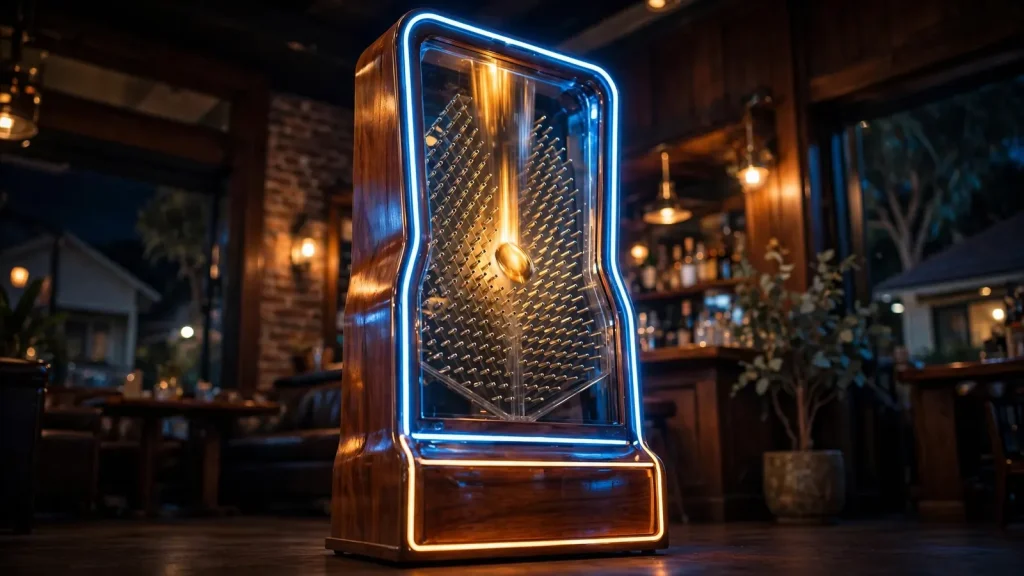
A guide to how Plinko games are presented, what reviews can establish, and how payments, bonuses and Australian regulation affect the picture.
Table of Contents
- Plinko as a Slot: The Familiar Cabinet, a Different Drop
- Online Plinko and the Offshore Boundary
- Real-Money Play, Cashouts and the Cost of Waiting
- One Game Name, Different Plinko Games
- What a Plinko Review Can—and Cannot—Establish
- Plinko in Australia: The Regulatory Record Behind the Search
- Free Play Is Not a Cash Balance
- Crypto Payments and the Unverified Script Question
- Bonus Terms: The Wagering Figure Is the Real Price
- Lucky, Guru and UK Searches: Labels Are Not Evidence
- Games &
Plinko as a Slot: The Familiar Cabinet, a Different Drop
Plinko borrows the visual grammar of a slot without necessarily being a slot in the old mechanical sense. The familiar cabinet is now a screen: a framed play area, a stake, an outcome, and the promise that a small movement can end somewhere consequential. But the image at the centre is not the turning reel. It is a falling token, or another object represented as one, moving through a field of pegs. The change is simple to picture and less simple to classify.
That resemblance matters. In ordinary conversation, “slot” can mean the cabinet in a club, the digital game on a phone, or almost any casino-style product organised around a stake and a result. Plinko sits near that broad category, but its drop gives it a different visual rhythm. Reels invite the eye to scan across symbols; a falling object invites it to follow a path. One is a row of possibilities, the other a descent. The screen does some of the same cultural work, though it tells a different story.
Choosing a Plinko casino in Australia means checking which details are actually available before deciding where to play. This list offers a concise reference to the stated licensing, deposit, and payout information for each operator.
1. Playfina Casino
License: Curacao eGaming (Hollycorn N.V., since 2017) · Min. deposit: A$20-30 (depends on the offer) Playfina Casino is listed with a Curaçao eGaming license held by Hollycorn N.V., which has been associated with the casino since 2017. Its minimum deposit is A$20–30, depending on the offer.
2. DragonSlots Casino
License: Curacao Gaming Authority (Jumpman Gaming Ltd) DragonSlots Casino is licensed by the Curaçao Gaming Authority under Jumpman Gaming Ltd. No deposit or payout details are provided here.
3. LevelUp Casino
License: Curacao eGaming OGL/2023/174/0082 (Dama N.V.) · Min. deposit: A$15 LevelUp Casino is listed under Curaçao eGaming license OGL/2023/174/0082, held by Dama N.V. Its stated minimum deposit is A$15.
4. Bizzo Casino
License: Curacao Gaming Control Board (TechSolutions Group N.V.) Bizzo Casino is listed with a Curaçao Gaming Control Board license under TechSolutions Group N.V. No deposit or payout details are provided here.
5. LuckyVibe
License: Curacao Gaming Control Board OGL/2023/176/0095 (Hollycorn N.V.) LuckyVibe is listed with Curaçao Gaming Control Board license OGL/2023/176/0095, held by Hollycorn N.V. No deposit or payout details are provided here.
6. Thor Casino
License: Curacao – Antillephone N.V. (Versus Odds B.V.) · Min. deposit: EUR 20 Thor Casino is listed with a Curaçao license under Antillephone N.V. for Versus Odds B.V. Its stated minimum deposit is EUR 20.
7. SpinsUp
License: Curacao Gaming Control Board OGL/2023/174/0082 (Dama N.V.) SpinsUp is listed under Curaçao Gaming Control Board license OGL/2023/174/0082, held by Dama N.V. No deposit or payout details are provided here.
8. SkyCrown
License: Tobique Gaming Commission · Payout speed: crypto ~10-15 minutes, fiat 1-5 days · Min. deposit: A$30 SkyCrown is licensed by the Tobique Gaming Commission and has a stated minimum deposit of A$30. Reported payout times are around 10–15 minutes for crypto and 1–5 days for fiat.
9. MrPacho
Payout speed: crypto 30-120 minutes, fiat 24-72 hours · Min. deposit: A$30 MrPacho has a stated minimum deposit of A$30. Reported payout times are 30–120 minutes for crypto and 24–72 hours for fiat.
10. Golden Pokies
License: Curacao Golden Pokies is listed as holding a Curaçao license. No further operator details are provided here.
A Plinko-style game may therefore be presented as a slot-style product without being a particular, standardised slot title. The label describes a family resemblance, not a guarantee about the software, rules or presentation behind it. A title containing “Plinko” could use the word as a central description, a theme, or part of a branded name. The cabinet may look familiar while the actual product differs. Names are not specifications.
This is why the phrase “Plinko slot” can mislead if it is taken too literally. It suggests one object waiting to be found, as though the name referred to a single machine with a settled design. In practice, the category can include distinct digital products assembled around a similar falling-token image. The slot frame tells something about how a product is positioned; it does not tell everything about what happens on screen or how an outcome is determined.
There is a small historical irony in the screen’s apparent simplicity. The old cabinet made chance visible through moving parts, lights and sound. Digital games can keep the theatre while removing the machinery from view. A Plinko image restores a visible journey: the token falls, changes direction, and reaches an endpoint. That makes chance appear legible. Yet watching a path unfold is not the same as seeing the underlying calculation. A displayed animation is a performance of an outcome, not an explanation of its probability.
Nor does the word “slot” settle the question of returns. A return-to-player percentage belongs to a particular game or a clearly identified group of games; it cannot be transferred by association from one provider, title or format to another. KA Gaming’s slot RTP percentages typically fall between 94% and 96%. That range is a provider-level detail about its slots generally, not a figure that can be attached to every Plinko game, or even to a Plinko-labelled title without product-specific confirmation. Similar packaging is not evidence of identical mathematics.
Games & Apps: Casino Options in Australia · Casino apps for Android in Australia: browser access
The distinction is especially useful when a product is described as a Plinko slot machine. The wording can evoke the physical EGM, but the digital version may have no cabinet, lever or mechanical reels at all. It may simply borrow the familiar arrangement of a play screen and a wager-based result. “Machine” in this setting often describes the inherited idea of a game, rather than an actual machine in a venue. The language travels more easily than the hardware.
The same caution applies to demo versions and themed titles. A free-play presentation can resemble a cash-play product, while a named edition can suggest an identity that is mostly visual. Neither appearance alone establishes that the underlying rules, probabilities or features match another version. And a title that sounds as if it belongs to a recognised series is not proof of a common manufacturer or shared design. The familiar cabinet is often a metaphor before it is a fact.
That leaves Plinko in an awkward but revealing place: close enough to slots to be grouped with them, different enough that the label can conceal more than it clarifies. It borrows the grammar of casino play—the framed screen, the stake, the anticipation of a result—while giving the eye a falling path instead of spinning reels. This is a description of form, not an invitation. Gambling is restricted to adults aged eighteen or older, and casino-style play can cause serious harm, particularly for vulnerable people.
Gambling Warning
Gambling is restricted to adults aged eighteen or older, and casino-style play can cause serious harm, particularly for vulnerable people.
The drop looks plain. The classification is not.
Online Plinko and the Offshore Boundary
A Plinko game can be visible on a website without that website being entitled to offer online casino services in Australia. The distinction is easy to miss because the screen presents a finished product: a game, a balance and familiar payment options. But digital availability is a fact about access, not a verdict about legality.
Australia’s Interactive Gambling Act 2001 restricts operators from providing online casino services to people in Australia. The boundary concerns the service being offered to someone physically here; it does not disappear because the game has a different name, a bright interface or a ball dropping through pegs rather than reels turning. A Plinko game presented as part of an online casino sits within that wider question of what service is being supplied.
That matters because “online casino” can sound like a place, while legally it is also an activity. A site may be hosted elsewhere, managed by a company elsewhere and licensed under rules elsewhere, yet still be directed at Australian customers. Offshore licensing describes the framework under which the operator claims to function. It does not amount to Australian permission to provide prohibited casino services to people here.
The internet, of course, is less tidy than the law. Offshore casinos often accept Australian payments and may display games to Australians. That practical accessibility can give the impression that the service is ordinary and locally authorised. It is not proof of either. A payment method can carry money across a border; it cannot carry an operator across the legal boundary.
Real-Money Casino Table Games in Australia: Legal Guide
The same distinction applies to searches for a Plinko casino online, an online casino with Plinko or a live version of the game. Those descriptions identify what someone hopes to find on a screen. They do not establish that offering it to Australian residents is lawful. Nor does the word “live” settle the matter: a live presentation remains an online casino service if that is what the operator is providing. Naming the format does not change the setting.
“Pokies” belongs to Australia’s everyday vocabulary for gambling machines, but familiar language can blur unlike things. A land-based venue and an online casino are not interchangeable simply because both offer games with gambling associations. The online boundary is specific: the Interactive Gambling Act addresses the provision of casino services over the internet to people in Australia. An online Plinko game cannot be made local by being described in familiar terms.
There is another distinction worth keeping intact: the law’s treatment of the operator is not the same as the law’s treatment of an individual player. Players are not criminalised simply for using offshore sites. That does not turn the operator’s offer into a lawful Australian service, and it does not make the site locally regulated. The two propositions can coexist without contradiction. One concerns the person accessing a service; the other concerns the service being offered.
This is why an offshore licence should not be read as a local guarantee. It may explain which jurisdiction claims oversight of the operator, but it does not alter the Australian restriction. A website’s polished appearance, Australian-dollar display or acceptance of local payments is similarly beside the point. They are features of access and presentation, not evidence that Australian law authorises the offer.
Attention: An offshore licence does not amount to Australian permission to provide prohibited casino services to people in Australia.
A game can also travel under several labels. “Plinko,” “Plinko casino game” and “Plinko pokies” may be used to describe a particular screen or a broader style of game. Whatever the label, the legal question does not turn on whether the game resembles a slot, a board game or a television attraction. It turns on the nature of the service and where the customer is located. The game’s theatrical simplicity—drop a ball, watch its path, wait for the result—does not simplify the legal position.
For Australian audiences, that separation between what can be reached and what may lawfully be offered is central. A site appearing online is not a local endorsement. An offshore licence is not an Australian one. And the fact that a player is not criminalised does not mean the online casino service itself is permitted. A narrow distinction, with real consequences.
Any gambling is for adults aged eighteen or older. Gambling can also cause serious harm, particularly for vulnerable people; a game’s casual appearance offers no protection from that risk. The legal boundary is not a measure of how harmless a game looks. It is a rule about who may offer online casino services to people in Australia.
Real-Money Play, Cashouts and the Cost of Waiting
A Plinko game described as real-money play involves more than a balance displayed beside the game. It means funds have been deposited, stakes can be deducted from them, and any resulting balance is subject to the operator’s rules before it can be withdrawn. A label such as “Plinko 2.0”, an app, or a downloadable version does not make those conditions disappear. The screen may make the process look immediate; the payment system rarely shares that theatrical instinct.
Australian Mobile Casinos: Sites, Apps and Offers
For people in Australia, this practical description should not be mistaken for an invitation to use an offshore casino. The legal position on online casino services is restrictive, and the word “real money” does not create an exception. Nor does a site’s willingness to accept Australian payments establish that its service is lawful to provide locally. Those are separate questions from whether a balance can, in practice, be requested for withdrawal.
The cashout threshold is one of the first terms that changes the meaning of a displayed balance. Offshore sites commonly set minimum withdrawals somewhere between A$75 and A$150. A smaller balance may therefore be visible without being eligible to leave the account. The distinction is simple but consequential: a number shown on screen is not necessarily an amount that can be transferred. If the threshold is higher than the balance, the account may remain short of the operator’s stated minimum.
That gap can also shape how a balance is understood. A player may see winnings accrue in small increments, while the withdrawal rule applies to the total amount requested rather than to each game result. The relevant question is not only whether a game records a win, but whether the account balance has reached the amount the operator permits to be withdrawn. Terms can also set out how a request is submitted and what conditions must be met. Those details are part of the cashout, not minor housekeeping.
Cashout Thresholds
Offshore sites commonly set minimum withdrawals between A$75 and A$150, meaning balances below this amount may not be eligible for transfer.
The first withdrawal often brings a separate obstacle: KYC, or identity checks. A site may ask for documents such as a passport or driver’s licence, along with a utility bill. This process is intended to establish identity and address, and it can mean that a first cashout requires more than entering bank details. A name mismatch, an unreadable image or an incomplete document set can leave a request pending while the operator seeks clarification. The practical cost is time, even when the balance appears ready to move.
There is a difference between account verification and approval of a particular withdrawal. Passing an identity check does not necessarily mean every balance is immediately withdrawable. The site may still examine the source of the funds, any applicable account conditions and whether the requested amount meets its minimum. A real-money deposit and a bonus-derived balance can sit beside each other on one screen while being treated differently in the terms. The interface is tidy; the accounting may not be.
Bonus-derived funds are not cash simply because they appear in a cash balance field. They may carry wagering conditions that must be met before winnings connected to the bonus can be withdrawn. A specialist review reported requirements stated at 30–50 times the bonus amount; that is a report about the terms it examined, not a fixed rule for every site or promotion. The condition attached to a bonus can therefore matter as much as the amount displayed. Without satisfying it, a balance may remain unavailable for cashout.
This is why “no deposit” and “real money” do not automatically belong in the same category. A promotion may create a balance without a cash deposit, but the resulting funds can still be subject to conditions and may not be freely withdrawable. The word “bonus” describes a promotional credit, not cash in hand. The withdrawal terms decide what happens next.
Mines Casino Game in Australia: Search Guide
Any assessment of a real-money balance must account for the threshold, KYC checks and restrictions attached to bonus-derived funds. These are practical features of an account, not proof that a service is appropriate or lawful for Australian residents. Gambling can cause serious harm, particularly for vulnerable people; an apparent cash balance is no measure of safety or income. The screen is not the settlement.
One Game Name, Different Plinko Games
“Plinko” can describe a kind of game without identifying one particular product. That distinction is easy to miss when a title appears in a list beside other casino games: the shared label suggests a common object, while the details that distinguish one offering from another may sit elsewhere—in its full title, its provider information or its rules.
A familiar name does not establish a single standard. One listing may use Plinko as the game’s name; another may use it to describe a broader format. A third may place the word in a promotional heading or category label. Those uses can look alike in a catalogue while referring to different things. The word is doing several jobs at once.
That is why “the Plinko game” is often too definite a phrase. It can imply a canonical version against which every other version can be measured. But a label alone cannot tell whether two listings refer to the same title, whether they share a supplier, or whether their terms match. Similar names are evidence of a naming resemblance, not proof of a common product.
The distinction matters most when descriptions are sparse. A tile may show only a short name and an image; a page may use a broad category heading; a result may shorten a longer title to fit a small space. None of those fragments settles the identity of the game. The full title and the information attached to that particular listing matter more than a familiar keyword.
Game Identification
- A shared name like “Plinko” does not guarantee a common product or supplier.
- Full titles and provider information are more reliable than familiar keywords.
- A category label is a description of form, not a specific identity document.
Nor should a shared name be taken to mean that every game works in the same way. The label does not, by itself, establish identical rules, settings or outcomes. Those claims require details tied to the specific title. A description that says only “Plinko” leaves a great deal unresolved. That is not a flaw in the word; it is the limit of what a word can prove.
This also explains why the same phrase can appear in different contexts. A person looking for a Plinko casino game might encounter a game title, a category page, a discussion of a game format or a reference to a particular service. These are not interchangeable. A category is not a title, and a title is not a guarantee that another listing with the same shorthand describes the same product.
The phrase “Plinko ball game” can make the label seem more exact, but adding a descriptive word does not identify a provider or a particular release. Likewise, placing “casino” before or after the name changes the wording, not the evidence. A string of familiar terms can sound like a precise product name while remaining only a broad description.
For the same reason, a platform name attached to Plinko should be read as a separate claim. It may indicate where a listing is presented, but it does not establish that the platform created the game, that another version is identical, or that the label has one official meaning across different catalogues. Names travel easily. Their provenance does not.
Best Casino App for iPhone in Australia: A Guide
The useful distinction, then, is between the game category and the individual item. The category tells what kind of thing a listing claims to be; the item’s own title and accompanying information say what that listing actually identifies. When those details are absent or abbreviated, certainty should stop there. A familiar label can be a signpost, but it is not an identity document.
One name, several possibilities.
What a Plinko Review Can—and Cannot—Establish
A review is an argument about a game, not a certificate for it. It may describe what the reviewer saw, compare features or judge how clearly information is presented. Those observations can be useful, but they are not interchangeable with details that can be checked independently. A confident tone does not make a claim verifiable.
That distinction matters when a review names a particular Plinko title. A page about Plinko Rush, Plinko Deluxe or another branded version may concern a specific product, while a general discussion of Plinko casino games may gather several products under one label. The headline alone cannot establish that two names refer to the same game, or that a reviewer has examined the precise version being discussed.
Numbers require the same care. KA Gaming slot titles typically have RTP percentages in the 94%–96% range. That range describes KA Gaming slots generally; it does not establish the RTP of a particular Plinko game, nor does it identify that game’s provider. Applying a broad figure to an individual title would turn context into a claim it cannot support.
Attention: Broad provider RTP ranges (such as KA Gaming’s 94%–96%) cannot be attached to every individual Plinko game without product-specific confirmation.
The word “review” can also cover very different work. One page may record observable details and explain how they were checked. Another may offer a verdict built mainly from promotional language. Useful signs of an assessment include a clear identification of the product, a distinction between firsthand observation and general explanation, and claims specific enough to be checked. Those signs improve the quality of the account; they do not, by themselves, prove every statement in it.
A search for a free version raises a different question from a review of a real-money product. The label “free” may describe a mode, a demonstration or simply wording in a page title. It does not establish what is available, what the mode contains or whether it behaves like another version. Likewise, a claim that a Plinko game is connected with a celebrity, or belongs to a casino with a name such as Verde, should not be treated as established merely because the association appears in a headline.
The same applies when a review asks what Plinko is: an explanation of the name is not evidence about a specific title. For people under eighteen, gambling is not an option; for adults, reviews remain assessments rather than guarantees. The small discipline of separating observation from inference is more valuable than a star rating. Reviews can orient. They cannot turn a label into proof.
Plinko in Australia: The Regulatory Record Behind the Search
A game’s name can travel freely; the service around it cannot. In Australia, the Interactive Gambling Act 2001 prohibits operators from providing real-money online casino games to people in the country. Enforcement sits with the Australian Communications and Media Authority (ACMA), the federal regulator responsible for monitoring compliance with interactive gambling laws.
Live Baccarat Online in Australia: Rules and Risks
ACMA’s powers have a practical edge. It can ask Australian internet service providers to block websites that supply prohibited gambling services or advertise them locally. The block is aimed at access to a site, not merely at the wording of a game title. A Plinko label therefore does not sit outside the regulatory system simply because it describes a particular style of play.
The scale of enforcement is substantial. Since November 2019, ACMA has blocked more than 1,455 illegal gambling and affiliate websites following enforcement action. Reports of services leaving the market since enforcement began in 2017 do not agree on a single count: one gives a figure above 210, while another says more than 190. Both describe a sustained effort to remove prohibited services from the Australian market.
That record belongs to a wider Australian argument about gambling, not to Plinko alone. Pokies have long occupied a familiar place in pubs and clubs, while their social costs have drawn political scrutiny. A report by gamble.com.au put Victorian poker-machine losses at $2.6 billion over a year, more than $44.7 million above the reported 2015 figure. Those amounts concern poker machines, not online Plinko, and cannot be treated as evidence about the outcomes of a different game.
The political response has included proposals to restrict the size of a poker-machine bet. Senator Nick Xenophon and MP Andrew Wilkie proposed a $1 limit. Such proposals reflect a recurring tension: gambling is presented as entertainment, yet its losses accumulate in households and communities, often far from the language of leisure. Problem gambling can cause serious harm, particularly for vulnerable people.
A search for a Plinko casino in Australia therefore lands in a country where the regulator blocks prohibited services and where gambling’s social consequences remain contested. The title may be novel. The argument around gambling is not.
ACMA Enforcement Record
Since November 2019, the ACMA has blocked more than 1,455 illegal gambling and affiliate websites. Other reports indicate that over 190 to 210 services have left the market since enforcement began in 2017.
Free Play Is Not a Cash Balance
“Free play” can describe a game run with credits that have no cash value, or a promotional balance attached to an account. Those are not the same thing. In a no-cash mode, the displayed result is part of the play experience; it does not become a sum available for withdrawal. A bonus balance may look more like money because it sits beside an account balance, but its appearance does not settle what can be taken out.
The distinction matters in Plinko as much as in any other casino-style game. A free-play version may let someone see how a particular title behaves without staking cash. A promotional credit, by contrast, can come with conditions governing whether any winnings from it become withdrawable. Until those conditions are met, the balance is not equivalent to cash.
Wagering rules are the hinge. A specialist review describes bonus terms in the 30–50x range, but that is a reported range, not a universal rule or a promise about a particular offer. The operator’s terms determine what counts toward wagering, which games qualify, and whether a bonus expires or is removed under stated conditions. A game labelled “free” can therefore mean play without a cash stake, or it can mean a bonus that carries obligations. The label alone explains little.
The same caution applies to free spins. They are a promotional format, not proof that winnings are immediately withdrawable. Any resulting amount may remain subject to the promotion’s conditions. The useful distinction is not between a large and a small balance, but between funds that are cash and funds still governed by rules.
Inclave Casinos in Australia: What Login Proves
For Australian readers, this is a description of how such terms work, not an invitation to use an online casino. Gambling can cause serious harm, particularly for vulnerable people; it is for adults aged 18 or older only. A balance on a screen is not a bank balance.
Crypto Payments and the Unverified Script Question
Crypto can make a withdrawal look like a clean transfer: a balance leaves one account and appears in a wallet. Yet the amount arriving is not necessarily the amount requested. A specialist review describes crypto withdrawals as potentially the quickest option, while noting that network fees and conversion spreads can eat into the proceeds. The speed is only one part of the transaction.
A network fee is charged for processing a transfer on its blockchain. A conversion spread is the gap between the rate used to exchange one currency or token for another and the rate a player might see elsewhere. Together, they can make the final amount smaller, even when the withdrawal itself clears promptly. The distinction matters: “sent” and “received” are not always the same figure.
That account is a description of a payment method, not an endorsement of a casino. In Australia, the Interactive Gambling Act 2001 prohibits operators from providing real-money online casino games to people in the country. A crypto payment does not change the nature of the service or its legal status. The machinery of payment is not a loophole.
The word “script” raises a separate issue. In software, it can mean code used to create or operate a game or website; in a listing, it might instead be a label attached to a product for sale. Neither use establishes that a particular Plinko game is genuine, complete, safe or available. A familiar name can travel farther than the thing it supposedly names.
Crypto Withdrawals
While often the quickest option, crypto payouts can be reduced by network fees and conversion spreads.
A claim that a Plinko casino script exists therefore needs more than the phrase itself. It would require identifiable information about what the code does, who made it and what product it produces. Without those details, the term remains ambiguous, not evidence of a verified game or service. Crypto and code are different questions, despite their tendency to meet in the same corners of the internet.
Bonus Terms: The Wagering Figure Is the Real Price
A bonus advertised as a gift arrives with arithmetic attached. Its headline value says little about the work required before bonus-derived winnings can be withdrawn; the wagering requirement determines how much betting must be recorded first. The bonus is not cash in hand.
One specialist review gives a specific illustration: a $100 bonus with a 40x wagering requirement calls for $4,000 in bets before winnings derived from it can be withdrawn. That is an example from a review, not a universal condition. The multiplication is simple; the effect is less so. A large turnover requirement can make a seemingly generous offer difficult to realise, especially when the games played count differently toward the target.
The contribution rate matters. A specialist review notes that blackjack may count for only 10% of wagering. Under that condition, a $100 blackjack bet would add only $10 toward the requirement. The apparent pace of progress can therefore differ sharply from the amount actually staked. A bonus tied to one game may behave differently from the same bonus tied to another.
This is why a no-deposit offer is not automatically cost-free. The entry price may be absent, while the conditions governing any resulting winnings remain substantial. For a Plinko promotion, the relevant detail is not merely the bonus amount but the written rules: the wagering multiple, which games contribute, and how much each contributes. A familiar game name does not establish that its bets count in full.
Online Pokies with E-Wallets in Australia
Promotional language tends to place the gift in the foreground and the calculation in smaller print. The calculation is the more candid part. In Australia, real-money online casino services are prohibited when offered to people in the country, so these terms are not an invitation to participate. They are a reminder that “bonus” describes the label, not the value.
Lucky, Guru and UK Searches: Labels Are Not Evidence
A name that sounds like a casino brand can carry more suggestion than information. “Lucky” may be part of a product name, a promotional label or simply a word attached to Plinko. Without reliable details tying it to a specific game or service, the label cannot establish who operates it, what the game contains or whether the name refers to a distinct product at all.
The same caution applies when a UK audience appears to be implied. A British reference may describe the intended readership, a site’s presentation or merely the wording used to describe a page. It does not, by itself, confirm that a service is available in the United Kingdom, or establish the terms under which it operates there. Geography in a label is not a licence.
iPad Casinos in Australia: Legal and Practical Guide
“Guru” can sound like a stamp of expert approval. But a reference to a casino guide or reviewer does not show that a particular Plinko title has been assessed, nor what such an assessment concluded. A useful review would need to identify the game and distinguish observable details from judgement. The title alone does neither.
This is a small but consequential distinction. Online labels are built to compress: a few words suggest luck, expertise or a country, while leaving the underlying facts elsewhere—or absent. Treating those suggestions as evidence turns a phrase into a claim it has not earned.
For Australian readers, a foreign-facing description does not alter the domestic legal boundary. The Interactive Gambling Act 2001 prohibits operators from providing real-money online casino games to people physically in Australia. A UK reference or an approving-sounding name cannot change that. Labels travel easily. Legal status does not.
Games &

Australian Mobile Casinos: Sites, Apps and Offers
A practical look at browser access, app shortcuts, payments, bonus conditions and the limits of...

Casino apps for Android in Australia: browser access
Learn how browser-based access, home-screen shortcuts and bonus terms shape casino use on Android. The...

Best Casino App for iPhone in Australia: A Guide
See how browser access, app listings, real-money play and free pokies differ on an iPhone...

Casino Apps in Australia: What “App” Really Means
The guide distinguishes browser sites, home-screen PWAs and downloads, then examines payments, bonuses, withdrawals and...

Instant Withdrawal Casinos in Australia: What to Check
“Instant” can describe only part of a payout: payment choice, verification and operator processing all...

International Casinos for Australian Players: 2026 Guide
A practical look at Australia’s legal line, mobile access, bonus conditions and the costs and...

Offshore Casinos for Australian Players: Assessing Claims
Browser-based play, legal limits, bonus conditions and payment routes affect what an offshore casino offers—and...

Casino Dice Games in Australia: Online Rules
The guide separates the mechanics and atmosphere of dice play from the legal limits on...

Crash Casino Games in Australia: How They Work
Crash games turn a rising multiplier into a cashout decision, but the visible pace of...

Inclave Casinos in Australia: What Login Proves
An Inclave sign-in may provide a route into an account, but it does not establish...

iPad Casinos in Australia: Legal and Practical Guide
The device does not change the rules: Australia prohibits operators from supplying online casino games...

Live Baccarat Online in Australia: Rules and Risks
Australia has no locally licensed online casinos, while international platforms may accept Australian players; this...

Live Blackjack at Online Casinos in Australia: Legal Limits
Australia’s rules distinguish familiar casino play from real-money online services, shaping what can be offered...

Live Roulette in Australia: Dealers and Legal Limits
The article explains Australia’s legal boundary and what the available evidence does—and does not—establish about...
Mines Casino Game in Australia: Search Guide
A guide to demos, bonuses, withdrawals and strategy claims in Australia's distinct pokies and online-gambling...

Online Pokies with E-Wallets in Australia
E-wallets handle deposits and withdrawals, while mobile casino play usually runs through a browser rather...
Real-Money Casino Table Games in Australia: Legal Guide
The guide distinguishes Australia's online casino restrictions from payment choices, odds evidence and the rules...

Online pokies Australia: real-money no-deposit offers
No-deposit labels do not establish legality or safety, and bonus play can come with wagering...

Real Money Pokies on Android in Australia: Legal Guide
Australian rules focus on the operator’s offer, while individual play is treated differently under the...

Real-Money Pokies in Australia: Apps and Browser Play
Many mobile casinos work through a browser, so understanding the difference between a website and...



































































































































































































