
Solana casino comparison in Australia: key checks
 Available in AU
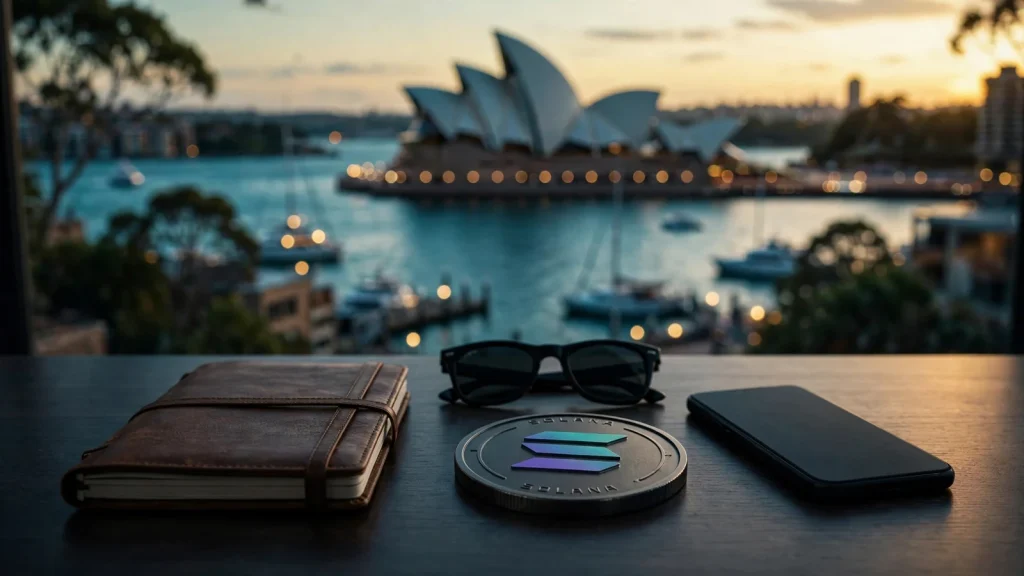
SOL can be legally transferred in Australia, while offshore online casino services remain prohibited under the Interactive Gambling Act 2001.
Table of Contents
- The Legal Grey Zone Around Solana Casinos in Australia
- How SOL Moves from an Australian Exchange to a Casino Wallet
- What a Solana Casino Comparison Can—and Cannot—Verify
- Fast on the Network, Not Always at the Cashier
- Solana Slots, Bonus Funds and the Price of Playthrough
- NFT Labels Do Not Establish Casino Utility
- SOL, USDC and the Nearly Invisible Network Fee
- Casino Games, Wagering Multipliers and the Arithmetic of a Bonus
- SOL Winnings and Australia’s Tax Distinction
- Website Blocking and the Limits of Offshore Recourse
- True Blue Casino Payments in AUD: Deposits, Cards and Bitcoin
The Legal Grey Zone Around Solana Casinos in Australia
SOL is not contraband in Australia. Australians may buy, hold and transfer it. The legal difficulty begins when the token is used to gamble with an offshore operator: the asset and the service are treated differently. A lawful transfer of cryptocurrency does not make the activity at the other end lawful.
The Interactive Gambling Act 2001 prohibits overseas operators from providing online casino services to people in Australia. That prohibition covers real-money casino games, including slots, poker and table games. A casino accepting SOL rather than Australian dollars does not escape the rule; changing the payment rail does not change what the service is. In this sense, the grey zone is less a gap in the law than an uneasy division between a legal digital asset and a prohibited service offered through it.
The Act is directed at operators, not at individual Australian players. A person who uses an offshore Solana casino is not directly penalised under that framework. That distinction can sound reassuring, but it is not a legal endorsement. The operator’s prohibition remains, and the player does not acquire the protections that would come with a locally regulated service. A lack of direct player liability is not the same as a safe or recognised market.
Choosing a Solana casino in Australia calls for checking the details that are actually available, such as licensing, deposit minimums and payout information. Use these notes as a starting point and verify the terms that apply to your location before playing.
1. Playfina Casino
License: Curacao eGaming (Hollycorn N.V., since 2017) · Min. deposit: A$20-30 (depends on the offer) Playfina Casino is listed with a Curacao eGaming license held by Hollycorn N.V., which it has had since 2017. Its minimum deposit is A$20–30, depending on the offer.
2. DragonSlots Casino
License: Curacao Gaming Authority (Jumpman Gaming Ltd) DragonSlots Casino is listed under a Curacao Gaming Authority license held by Jumpman Gaming Ltd.
3. LevelUp Casino
License: Curacao eGaming OGL/2023/174/0082 (Dama N.V.) · Min. deposit: A$15 LevelUp Casino is listed with Curacao eGaming license OGL/2023/174/0082, held by Dama N.V. Its stated minimum deposit is A$15.
4. Bizzo Casino
License: Curacao Gaming Control Board (TechSolutions Group N.V.) Bizzo Casino is listed under a Curacao Gaming Control Board license held by TechSolutions Group N.V.
5. LuckyVibe
License: Curacao Gaming Control Board OGL/2023/176/0095 (Hollycorn N.V.) LuckyVibe is listed with Curacao Gaming Control Board license OGL/2023/176/0095, held by Hollycorn N.V.
6. Thor Casino
License: Curacao – Antillephone N.V. (Versus Odds B.V.) · Min. deposit: EUR 20 Thor Casino is listed under a Curacao license held by Antillephone N.V. for Versus Odds B.V. Its stated minimum deposit is EUR 20.
7. SpinsUp
License: Curacao Gaming Control Board OGL/2023/174/0082 (Dama N.V.) SpinsUp is listed with Curacao Gaming Control Board license OGL/2023/174/0082, held by Dama N.V.
8. SkyCrown
License: Tobique Gaming Commission · Payout speed: crypto ~10-15 minutes, fiat 1-5 days · Min. deposit: A$30 SkyCrown lists a Tobique Gaming Commission license and a minimum deposit of A$30. Its stated payout times are around 10–15 minutes for crypto and 1–5 days for fiat.
9. MrPacho
Payout speed: crypto 30-120 minutes, fiat 24-72 hours · Min. deposit: A$30 MrPacho lists a minimum deposit of A$30. Its stated payout times are 30–120 minutes for crypto and 24–72 hours for fiat.
10. Golden Pokies
License: Curacao Golden Pokies is listed with a Curacao license.
The law also leaves a practical question hanging over crypto gambling. A specialist review reports that, as of mid-2026, Australia had not established a specific licensing framework for crypto-gambling operators. That does not turn offshore sites into authorised venues. The broader prohibition on providing online casino services still applies, even when a platform presents itself as a crypto product rather than a conventional casino. Labels are not licences.
For anyone using an offshore Solana casino, the more immediate weakness is the absence of Australian legal protection if the operator freezes an account or withholds winnings. The problem is not simply that a dispute may be inconvenient. There may be no Australian casino regulator able to require the offshore business to release funds or resolve the complaint under local gambling protections. The operator may be accessible online while remaining beyond the ordinary remedies available at home.
This uneven arrangement reflects a familiar feature of internet regulation: the service can cross a border more easily than the rules designed to govern it. Cryptocurrency adds a new form of payment, but not a new guarantee of consumer rights. The same distinction matters whether a balance is displayed in SOL or another token; a casino’s interface does not confer legal standing.
EcoPayz Casino Sites in Australia: What to Know
Nor does the absence of reported prosecutions establish that offshore play is legally safe. Enforcement history and legal status are separate questions. A quiet record may describe what has happened so far; it cannot repeal the Act or promise what will happen next. Equally, the fact that the law targets operators rather than punters should not be mistaken for official approval of a player’s choice.
The result is a narrow but consequential position: holding and transferring SOL is lawful, while offshore operators are prohibited from supplying online casino services to Australian residents. Players are not directly penalised by the Act, yet they may have no Australian legal protection if funds are withheld. Grey, but not harmless.
How SOL Moves from an Australian Exchange to a Casino Wallet
The route from Australian dollars to a casino balance is usually indirect. Most Solana casinos do not accept AUD deposits by bank transfer or card. Instead, funds pass through an Australian exchange: AUD is deposited there, converted into SOL, and then sent to a wallet address provided by the offshore gambling platform.
That sequence matters because the exchange and the casino are separate services. A bank transfer or PayID payment puts Australian dollars into the exchange account; it does not send money to the casino. SOL must first be purchased, then withdrawn from the exchange to the destination wallet. The casino credits the balance after receiving the transfer.
Funding a Casino
Step 1: Deposit AUD
Transfer Australian dollars into a domestic exchange account using PayID or bank transfer.
Step 2: Convert to SOL
Purchase Solana (SOL) within the exchange platform using the deposited AUD.
Step 3: Transfer to Wallet
Withdraw the SOL from the exchange to the specific wallet address provided by the offshore casino.
Step 4: Credit Balance
Wait for the casino to receive the transfer and credit the balance to the gambling account.
Swyftx, CoinSpot and Coinbase AU support AUD deposits by PayID or bank transfer. The available route therefore begins with a conventional domestic payment, but its endpoint is a cryptocurrency balance rather than an Australian-dollar casino account. The exchange is the conversion point between the two systems.
Conversion brings its own checks
Services that convert between SOL and AUD are subject to KYC/AML requirements. In practice, that means the exchange may require identity and account checks as part of its conversion service. Those checks belong to the on-ramp—the service turning AUD into cryptocurrency—not to the casino’s own account rules.
The distinction can become important later. A player may have passed an exchange’s checks and still face separate KYC checks at an offshore casino, particularly when making a larger withdrawal or cashing out bonus funds. Verifying an exchange account does not establish that a casino account has been verified, nor does it guarantee that the casino will release a balance.
This is one of the less visible features of the payment route. A single deposit can involve a bank, an exchange and an offshore operator, each with its own account records and procedures. The transfer may look like one movement of value on a screen; administratively, it is a chain.
The wallet address is the hand-off
After the SOL purchase, the exchange’s withdrawal function is used to send funds to the casino wallet address. That address is supplied by the platform, and the amount entered is denominated in SOL rather than AUD. The balance shown in Australian dollars may therefore change with SOL’s market price even if the number of SOL units remains the same.
Bitcoin Casinos in Australia: Legal and Payment Guide
The address is not a bank account number that can be corrected after sending. SOL transfers are irreversible, and funds sent to the wrong address can be lost permanently. Copying an address carefully and confirming that it matches the intended destination are basic safeguards, not formalities. A mistaken transfer has no ordinary chargeback path.
The same volatility affects the value of winnings. If SOL falls in value between a deposit and a later withdrawal, the Australian-dollar value of the balance can shrink even when the SOL amount has not changed. Conversion creates exposure to the token’s price, not merely a different way of labelling cash.
A specialist review has reported minimum SOL deposits ranging from 0.01 to 0.1 SOL, equivalent to approximately AUD$2.80–$28 at April 2026 prices. That range is a reported snapshot, not a standing feature of every casino: both platform rules and the AUD value of SOL can change. The deposit minimum displayed by a particular service is the operative figure, and a small minimum does not make the wider payment route low-risk.
Why the route is not a direct AUD deposit
An Australian-dollar payment can feel familiar because it begins through a local exchange, but the casino does not thereby become an Australian payment merchant. The exchange converts the currency; the user then controls a SOL transfer to an offshore wallet. That separation is precisely why a direct bank deposit into a casino balance is not the normal arrangement for these platforms.
Legal Risk
Offshore operators are prohibited from providing online casino services to people in Australia under the Interactive Gambling Act 2001.
It also means that the exchange’s payment options should not be confused with the casino’s. PayID or bank transfer may be available for funding an Australian exchange account, while the casino receives SOL. Most Solana casinos do not offer a direct AUD bank-transfer or card deposit. The payment path is conversion followed by transfer.
For a casino on Solana, the phrase “SOL deposit” describes the final leg, not the whole journey. Australian dollars first enter a conversion service, pass through its account and compliance process, and become a crypto asset held in a wallet. The casino balance is reached only after that asset is sent to the address the platform provides. There is no single Australian-dollar transaction from bank to casino.
This route can be read as a small map of the wider crypto economy: domestic payment rails at one end, an exchange acting as a gatekeeper, and a wallet transfer at the other. It adds steps that a conventional cash balance might conceal. Not fewer steps—different ones.
What a Solana Casino Comparison Can—and Cannot—Verify
A comparison can organise evidence; it cannot turn an offshore casino into a lawful Australian service. Under the Interactive Gambling Act 2001, overseas operators are prohibited from offering online casino games to people in Australia. A table of platforms, however carefully assembled, is not an assurance that playing there is legally safe or that Australian authorities can recover withheld funds.
Instant PayID Casino Withdrawals in Australia
The useful question is narrower: what can be checked, and how clearly? Licensing claims, published game information, fairness tools, withdrawal conditions, fees and bonus terms are separate pieces of evidence. They should not be blended into a single label such as “trusted”. A licence may identify the regulator an operator says oversees it, but it does not provide Australian consumer protection or guarantee that a dispute will be resolved in a player’s favour.
That distinction matters especially in a market where the legal framework is not a local endorsement system for crypto casinos. Any comparison should state what licensing information it has verified and avoid presenting an offshore licence as Australian approval. If the operator’s details are hard to locate, inconsistent or unsupported by the licensing authority, that is a limitation worth making visible, not smoothing over with a star rating.
Claims need their own evidence
Published RTP figures can help describe a game’s stated return over extended play, but they are not a promise about a particular session or a player’s outcome. A comparison should identify where RTP information comes from and whether it is attached to the game in question. A general statement about a casino’s catalogue is weaker than a figure that can be checked against the game’s own information.
“Provably fair” needs similar care. The label is useful only when the platform explains what can be verified and provides a working mechanism for doing so. The presence of a fairness tool does not establish that every game has been independently tested, nor does it settle questions about account handling or withdrawals. A comparison can report the evidence available; it cannot make a broad fairness guarantee from a technical label.
Do
- Verify where RTP information comes from
- Check for specific KYC requirements on withdrawals
- Review wagering contributions for each game
- Date the checks of published policies
Don’t
- Trust a general “trusted” label
- Assume a fairness tool guarantees all games
- Rely on speed claims without checking KYC rules
- Treat a page’s silence as proof of no fees
Withdrawal policies deserve more than a speed claim. The published rules should be checked for KYC checks, including whether larger withdrawals or bonus cashouts can require identity documents. Processing may be automated or manual, and a specialist review reports ranges from 5–15 minutes for automated operators to as long as 72 hours for manual processes. Those are reported timings, not a promise for an individual withdrawal: internal approval and network congestion can affect the result. The network may confirm a transfer quickly while the casino’s own queue remains unresolved.
Fees also need to be separated by type. A specialist review reports that some casinos impose a withdrawal charge of 0.1% to 1% of the amount. That is not evidence that every platform charges one, or that a listed fee is the only possible deduction. The terms should be checked for casino charges as well as any conditions that affect the amount released. A comparison that records “no fee” should make clear what was checked and when, rather than treating a page’s silence as proof.
A bonus is a set of conditions, not a headline
The advertised bonus amount alone says little about its practical value. The calculation needs to account for wagering, which games count and at what contribution, time limits and any maximum cashout cap. A generous-looking offer can become difficult to use when the qualifying games contribute differently or the available time is short. A comparison should show the conditions that shape the outcome, not simply repeat the promotional headline.
Casino Sites That Accept BPAY in Australia: What to Check
For that reason, cash-out terms belong in the assessment before any deposit, not as fine print discovered after a win. Bonus funds may come with restrictions, and winnings can be subject to further conditions before withdrawal. The point is not to predict what a player will win; it is to make the route from offer to withdrawable balance legible. If the terms are unclear or unavailable, the comparison cannot responsibly calculate the offer’s value.
There is also a limit to what a snapshot can establish. Terms can change, a page can be updated, and a stated policy is not proof that an operator will apply it consistently. A comparison should date its checks where possible and distinguish a published rule from an independently verified practice. Even a careful review cannot guarantee a payout or prevent an account dispute.
Finally, any partner link accompanying a comparison should be identified plainly as affiliate or promotional content. That disclosure lets readers distinguish editorial assessment from a commercial relationship; it does not validate the underlying claims. Nor does a ranking, where one appears in a separate table, remove the need to check the evidence behind each entry. Comparisons can make differences visible. They cannot make offshore play safe.
Fast on the Network, Not Always at the Cashier
A Solana transfer can feel almost instantaneous, which makes a delayed casino withdrawal seem like a network failure. The distinction matters. The blockchain handles the transfer after the casino authorises it; it does not decide when an operator releases funds.
Network vs Operator
A Solana transaction may be confirmed in 400 milliseconds, but the actual time to receive funds depends on whether the casino uses an automated or manual approval queue.
A specialist review puts Solana transaction confirmation at about 400 milliseconds, with balances updating immediately. That describes the network leg, not the time spent waiting for a casino’s cashier to approve a withdrawal. The operator may process requests automatically or leave them in a manual queue. A specialist review reports native SOL withdrawals processing in 30–60 seconds on competent platforms, and treats under 10 minutes as a fast network withdrawal. These are reported benchmarks, not a promise that an individual casino will meet them.
The queue is the slower institution. A manual review can add time before a transaction is sent at all; once it is broadcast, network confirmation is a separate step. A status marked “processing” may therefore describe the operator’s work, not activity on Solana. The cashier and the chain keep different clocks.
The distinction is especially important in Australia, where the Interactive Gambling Act 2001 prohibits offshore operators from providing online casino games to Australian residents. Speed does not change that position, and the lack of player prosecutions does not make offshore gambling legally safe.
SOL transfers are irreversible. If the casino wallet address is entered incorrectly, the funds can be lost permanently; there is no routine reversal desk on the blockchain. A fast network makes a correct transfer quick, and a mistaken one final.
Nor does a successful transfer guarantee that a withdrawal request will pass without questions. Larger withdrawals may prompt KYC checks and a request for identification. Bonus cashouts may also be reviewed under the operator’s terms, so a displayed balance is not necessarily money ready to leave. The relevant delay may arise before any SOL reaches the network.
Casinos That Accept CashtoCode in Australia: Key Checks
This is why claims about speed need to specify what is being timed: the casino’s approval, the sending of the transaction, or its confirmation. Those stages are not interchangeable, however neatly a cashier screen presents them.
Fast chain. Human queue.
Solana Slots, Bonus Funds and the Price of Playthrough
A slot bonus can look simple at the point of entry: spins are offered, a balance appears, and play begins. The important distinction arrives later, when winnings are divided between withdrawable cash and bonus funds. A displayed balance is not necessarily a cash-out balance.
Free-spin winnings may be credited as bonus funds rather than cash. One specialist review describes a separate wagering requirement of 50x applying to such winnings. That is a reported term, not a universal rule for Solana casino sites; the operator’s own bonus conditions determine what applies. Where winnings are held as bonus funds, they must be wagered with real money before withdrawal. A win on a spin can therefore begin another stage of the promotion rather than end it.
The word “wagering” can also conceal a difference between games. Slots typically count at 100% towards a requirement, while blackjack or roulette may count at only 10–20%. A player who moves from a slot to a table game may find that the bonus clears much more slowly than the amount staked suggests. The interface may display a single progress bar. The terms decide what moves it.
Attention High rollover requirements combined with the house edge can make a bonus negative in practical value due to repeated exposure to losses.
This is why the cash-out conditions belong before the deposit, not after a winning session. The relevant details include whether free-spin returns become restricted funds, which games count, how much each game contributes, and what happens to any remaining bonus if play stops. A high rollover paired with the house edge can make a bonus negative in practical value: the required volume of play creates repeated exposure to losses, while completing the requirement does not guarantee a profit. A large headline offer is not evidence of a generous one.
SOL adds a further complication. Its market price can shift between a deposit and a withdrawal, so a balance that has risen in token terms may still be worth less in Australian dollars. That risk sits beside the game’s own mathematics, not inside the bonus wording. The two can compound. A promotion may be cleared while the fiat value of the resulting SOL has fallen.
Cash-out rules also affect whether a player can access winnings at all. Larger withdrawals or bonus cashouts may trigger KYC checks and a request for identification. That is separate from wagering progress: a completed requirement does not itself ensure immediate release of funds.
Slot play can make a bonus feel tangible because each spin has a visible result. The account ledger is less theatrical. It distinguishes cash, restricted funds and progress towards release, and those categories matter more than the promotional headline. The sensible comparison is between the offer’s conditions and the amount of wagering they demand—not between banners.
Casino Sites That Accept Credit Cards in Australia
Read the terms first. The spin comes later.
NFT Labels Do Not Establish Casino Utility
An NFT label attached to a casino does not, by itself, explain what the token does. It may be part of a name, a promotional description or a reference to a digital collectible. None of those possibilities establishes that an NFT grants access, changes game terms, carries a benefit or has a use inside a gambling account. The distinction is plain, if easily blurred: terminology is not functionality.
A service described as an NFT casino on Solana still needs to be judged by what it actually documents. The label alone cannot show whether an NFT is involved in account access, whether it is connected to any game, or whether it has any practical role after purchase. Those are separate claims, and each would need clear, specific evidence. Without it, the word “NFT” is decoration rather than a dependable description of the service.
This matters because digital ownership language can borrow the authority of technology without clarifying the ordinary terms of a transaction. An NFT may sound like a ticket, membership or asset; the sound does not make it one. A platform’s own description can state an intended use, but that is not the same as independently established utility or a guarantee that the promised use will continue.
NFT Utility
An NFT label does not automatically grant access or change game terms. Its actual utility depends on the operator’s documented terms; without specific evidence, the label is considered decoration rather than functionality.
The same care applies to claims about value. A token being called collectible does not establish that it can be resold, that a market exists for it, or that it will retain value. Nor does an NFT label demonstrate that holding a token improves the odds, unlocks a benefit or protects funds. Any such claim would need to be assessed on its own terms, not inferred from the initials.
The practical question is therefore less “Is this an NFT casino?” than “What, precisely, is the NFT said to do, and where are the terms that explain it?” If the answer is vague, the label cannot fill in the missing detail. It should not be treated as proof of access rights, a cash equivalent, a safer account or a route to recover money.
There is also a difference between a casino that accepts SOL and a service whose operation is meaningfully tied to NFTs. The former describes a payment option; the latter would require substantiated detail about the token’s role. A “casino with Solana” may simply refer to SOL payments. Adding NFT language does not resolve what the platform provides or what obligations attach to a token.
The Australian legal position does not change with the label: the Interactive Gambling Act 2001 prohibits offshore operators from offering online casino games to people in Australia. An NFT description does not make that service legally safe. SOL itself can also change in value between deposit and withdrawal, so a token’s branding offers no shelter from price movement.
A careful comparison treats NFT wording as a claim to verify, not a feature to assume. Until the function and terms are clear, the label says little. That is the whole point.
Paysafecard Casino Sites in Australia: Key Facts
SOL, USDC and the Nearly Invisible Network Fee
A specialist review reports that some Solana casinos accept USDC on Solana as well as SOL. That gives the payment menu two distinct choices, but it does not make them interchangeable. A deposit has to match the token and network the platform supports; selecting the wrong option can turn a small-fee transfer into a much larger problem.
Solana’s average transaction fee is about $0.00025 USD per transaction, a cost so small that it can nearly disappear from the cashier’s arithmetic. The fee belongs to the network transaction, however, not to the casino’s own accounting. A platform may apply its own charges, and a negligible blockchain fee says nothing about whether a deposit, withdrawal or conversion carries an additional cost. “Nearly free” is not the same as free at every stage.
The distinction matters because the cashier is only one part of a payment path. The token must arrive in the correct form, be credited by the platform and, eventually, leave through whatever withdrawal process the operator permits. A fee shown by the Solana network covers none of those decisions. It is a narrow technical cost, not a certificate of fair dealing.
SOL also carries a different risk from a token whose value is intended to track a currency. Its market price can move between deposit and withdrawal, reducing the Australian-dollar value of winnings even when the number of SOL units has not changed. A tiny transfer fee cannot soften that movement. The cost of the railway may be negligible; the cargo can still lose value on the journey.
Token Choice
While USDC on Solana may avoid the price volatility of SOL, its availability is not universal and is subject to the operator’s specific network and withdrawal terms.
USDC on Solana may avoid that particular exposure only to the extent that the platform accepts it and the balance remains in that token. Availability is not universal, and a listed option should be checked against the cashier’s stated network and withdrawal terms. The choice is practical, not a guarantee: an operator can still impose its own conditions, and a low network charge offers no assurance that funds will be released promptly or without dispute.
This is the useful limit of the “cheap crypto casino” idea. Solana makes the transaction fee almost invisible; it does not make the surrounding payment arrangement invisible in any meaningful sense. Token support, platform charges and the volatility of SOL remain separate questions. The smallest line on the receipt is not necessarily the one that matters most.
Casino Games, Wagering Multipliers and the Arithmetic of a Bonus
A bonus can look generous when described as a balance and much less generous when translated into required bets. The calculation depends not only on the wagering multiplier but on which funds the multiplier applies to, which games count, and what happens to any balance left when the conditions are complete.
One specialist review describes a 40x requirement attached to a 5 SOL bonus. That means 200 SOL must be wagered before withdrawal becomes available. A separate specialist review describes a 35x requirement applying to the bonus alone. These are distinct terms, not a single offer: the wording matters as much as the multiplier. A requirement applying to the bonus and deposit together would produce a different total from one calculated on the bonus only.
Casinos That Accept Visa in Australia: What to Know
The game mix can lengthen the route. Slots may contribute fully to wagering, while blackjack and roulette may contribute only a fraction of each stake. A player switching from a qualifying slot to a table game may therefore make less progress against the requirement with the same amount wagered. Poker and other games can carry their own exclusions or contribution rules, so a general label such as “casino games” says little about what actually qualifies.
There is another subtraction, less visible than the multiplier. Games have a house edge: repeated wagering exposes the bonus balance to expected losses, while restricted game contributions can require more play to meet the same term. A large nominal bonus paired with demanding conditions can therefore have negative practical value. The arithmetic is not an assurance of a cashable return; it is a description of the play required before one may be possible.
Cash-out terms belong before the deposit decision, not after a win. Relevant clauses include the multiplier’s base, excluded games, contribution rates, expiry conditions and any cap on withdrawals. Bonus balances and winnings may also be subject to KYC checks before release, particularly where a cashout is larger. The promotion’s headline figure is only the opening line.
Checking Bonus Terms
- Identify the wagering multiplier base (bonus only or deposit + bonus)
- Check the contribution rate for each intended game
- Verify the maximum cashout cap
- Confirm the expiry date of the offer
- Review KYC requirements for bonus withdrawals
SOL adds a separate uncertainty. Its price can move between the deposit and withdrawal, reducing the Australian-dollar value of winnings even if the nominal SOL balance has increased. A completed wagering requirement cannot freeze that exchange value. The apparent prize and its eventual value are not the same thing.
SOL Winnings and Australia’s Tax Distinction
Australian tax treatment draws a line between gambling income and the asset used to place a bet. Recreational gambling winnings are generally not taxable. That principle does not make every later change in the value of a payout tax-free, however, when the payout is held in cryptocurrency.
The Australian Taxation Office treats cryptocurrency as an asset for capital gains tax purposes. Where SOL is used for gambling, profits are subject to Capital Gains Tax. The distinction is easy to miss: a win may arise from a recreational activity, while SOL remains an asset whose value can change. The tax question is therefore not exhausted by calling the money “gambling winnings”.
A SOL casino token is still SOL for this purpose; its use inside a gambling account does not turn it into a separate category of asset. If its value changes between the point it is received and a later disposal, that movement belongs to the asset side of the calculation. A casino balance can look like a number on a screen, but the tax treatment follows the underlying asset.
Losses create a further divide. A specialist review describes gambling losses as deductible against gains only when the player qualifies as a professional gambler, a status with a high threshold. Recreational losses should not be assumed to cancel capital gains simply because both arose from gambling activity. The two may sit in different tax categories, and the fact that one follows the other does not automatically join them.
Same-Day Payout Casinos in Australia: How Timing Works
This distinction matters when assessing any platform comparison or the apparent return from play. A reported win in SOL is not necessarily the same as a settled gain in Australian dollars, and price movement can alter its value before withdrawal. Tax records may therefore need to distinguish the gambling result from what happened to the crypto asset afterwards.
The neat label “winnings” can conceal two separate events: the result of a game and the change in value of SOL. Australian tax treatment does not collapse them into one. Dry arithmetic, but consequential.
Website Blocking and the Limits of Offshore Recourse
ACMA’s enforcement is visible in the way access to offshore gambling sites can be cut off. The authority can order unlicensed sites blocked under the Interactive Gambling Act 2001, and its public Gambling Prohibition Register identifies sites subject to that action. A specialist review reported that the register contained more than 200 entries in 2026; the figure is a dated snapshot, not a permanent count.
Blocking changes access, not the terms of a player’s relationship with an operator. An offshore platform may close, freeze an account or refuse to release funds, while Australian authorities offer no route for recovering money held by it. Consumer protections are limited, and a complaint does not turn an offshore operator into a locally accountable one. The screen may disappear; the balance does not thereby return.
VPN use adds another uncertainty. An operator may treat access through a VPN as a breach of its terms and seize an account or funds. A connection that appears to restore access therefore offers no assurance of continued access to an account or its balance.
Anonymous Crypto Casinos in Australia: Payments & Risk
These practical limits matter for any Solana casino considered from Australia. A site remaining reachable does not establish that it is permitted to serve Australian residents, nor does a blocked site’s appearance on a register settle what happens to funds already held there. Access and recourse are separate questions. The first can be interrupted by a block; the second may be absent when the operator is offshore.
Is it legal to use Solana casinos in Australia?
Australians can legally buy, hold and transfer SOL, but overseas operators are prohibited from offering online casino services to Australian residents. The law targets operators rather than players, though players may have no Australian legal protection if a casino withholds funds.
Are Solana casino winnings taxed in Australia?
Winnings from recreational gambling are generally not taxable as income in Australia. However, the ATO treats cryptocurrency as an asset, so profits from gambling with SOL may be subject to capital gains tax.
Can I use Australian dollars directly?
Usually not: most Solana casinos do not accept direct AUD deposits. You generally deposit AUD with an Australian exchange, buy SOL and transfer it to the casino’s wallet.
How does ACMA protect Australian online gamblers?
ACMA enforces the Interactive Gambling Act by blocking unlicensed offshore gambling websites. Its public Gambling Prohibition Register lists over 200 unlicensed gambling sites as of 2026.
How fast are Solana casino withdrawals?
Native SOL withdrawals can take 30–60 seconds on competent platforms, while a fast casino withdrawal should take under 10 minutes on the network. Casino processing can extend this to 5–15 minutes for automated operators or as long as 72 hours for manual processes.
Is it legal for Australians to gamble with Solana?
Australians may legally hold and transfer SOL, but offshore operators are prohibited from providing online casino services to Australian residents. Individual players are not directly penalised under the Act, but they may lack Australian legal protection if funds are withheld.
True Blue Casino Payments in AUD: Deposits, Cards and Bitcoin

True Blue Casino Withdrawals: Methods, KYC and Cashout Checks
True Blue Casino Australia Guide Current answer: True Blue Casino withdrawals are supported through Bitcoin...

Anonymous Crypto Casinos in Australia: Payments & Risk
Bitcoin addresses are pseudonymous, while account checks and operator processing can still shape privacy and...

Aussie Crypto Casinos: Rules, Risks and Verification
Crypto payments do not confer Australian licensing; this guide examines offshore rules, verification limits, bonuses,...

Online casino payment methods for Aussie players
Payment routes can involve a bank account, a wallet and a processing provider, so the...

Casino Sites That Accept Amex in Australia
Amex availability depends on the operator and location, and a payment option being listed does...

Casino Sites That Accept BPAY in Australia: What to Check
The article distinguishes advertised deposits from confirmed payment access, withdrawal routes, operator status and game...
Casino Sites That Accept Credit Cards in Australia
Card acceptance does not determine whether an offshore casino may offer real-money games to people...

EcoPayz Casino Sites in Australia: What to Know
Australian online gambling rules, EcoPayz acceptance claims and withdrawal conditions are distinct questions that require...

Casino sites that accept Osko in Australia: key facts
The article examines Osko deposit and withdrawal claims alongside Australia's prohibition on real-money online casino...

Paysafecard Casino Sites in Australia: Key Facts
A Paysafecard mention does not confirm a deposit or withdrawal route, and Australian law shapes...

Skrill Casino Sites in Australia: What to Verify
Skrill availability, withdrawal speed and casino games are separate questions, and the available details do...

Trustly Casinos in Australia: What Can Be Verified
It examines the legal boundary for offshore casino services and why available information does not...

Under an Hour Casino Withdrawals in Australia
A withdrawal’s timing depends on operator approval as well as the transfer from approval to...
Casinos That Accept Apple Pay in Australia: What to Know
Apple Pay is common for everyday contactless payments in Australia, but that does not establish...

Bitcoin Casinos in Australia: Legal and Payment Guide
Bitcoin affects how funds move, but the operator’s location and status determine how an online...

Bitcoin Cash Casinos in Australia: Legal Checks
Payment options do not establish that a casino is verified or change the Australian rules...
Casinos That Accept CashtoCode in Australia: Key Checks
CashtoCode availability alone cannot establish an operator’s status, withdrawal support or bonus eligibility in Australia....
Ethereum Casinos in Australia: Understanding ETH Acceptance
Ethereum identifies a payment method, not a type of casino, and does not establish an...
Google Pay at Australian Casinos: What the Evidence Shows
Google Pay is a wallet, not proof that an online casino may lawfully offer real-money...

Casinos That Accept Litecoin in Australia: Legal Context
A cashier listing Litecoin does not establish that an offshore casino is authorised to offer...

Casinos That Accept Mastercard in Australia
Card availability depends on the operator and payment route, while deposit access does not establish...

Casinos That Accept MiFinity in Australia: The Evidence
A careful look at payment claims, withdrawal details and the legal limits affecting offshore online...
Casinos That Accept Neosurf in Australia: What to Check
A search result alone cannot verify that a casino accepts Neosurf, serves people in Australia,...
Casinos That Accept Neteller in Australia: Legal Context
The Act covers online casino games regardless of an operator’s location or whether an account...

PayID Casinos in Australia: What Is Verified
The available evidence covers an American Express deposit process, not a verified list of Australian...

Casinos That Accept PayPal in Australia: What to Check
An evidence-led look at PayPal claims, withdrawal checks and the difference between offshore availability and...

Casinos that accept POLi in Australia: what to know
The Interactive Gambling Act 2001 prohibits operators from offering online casino games to people in...

Casinos That Accept Tether USDT in Australia
The guide distinguishes crypto transaction features and casino acceptance claims from the separate question of...

Casinos That Accept Visa in Australia: What to Know
Visa availability does not establish that an offshore casino may lawfully offer real-money games to...

Easy Withdrawal Casinos in Australia: Payout Timing
A clear look at operator approval, payment-network timing, identity checks and the conditions that can...

Fast Withdrawal Casinos in Australia: Approval Times
A withdrawal may move quickly after release, while operator checks and the payment route shape...

Instant Bank Transfers at Australian Casinos: PayID
PayID is bank-linked, but sending a transfer and having it credited are separate steps, within...

Instant PayID Withdrawals in Australia: Timing Explained
PayID’s near-real-time transfer starts only after operator approval, while identity checks, eligibility and banking processes...

Instant PayID Casino Withdrawals in Australia
PayID can move released funds quickly, but operator checks and Australian legal restrictions remain separate...

PayID Pokies in Australia: How Payments Work
PayID uses a phone number or email address to route bank transfers, but it is...

No-Verification Withdrawal Casinos in Australia
A practical look at deferred identity checks, payment timing, bonus wagering gates and the limits...

No KYC Casinos in Australia: What to Expect
A practical look at identity checks, crypto and other payment routes, withdrawal timing, and the...

Online pokies instant withdrawals in Australia
Withdrawal speed depends on operator review, approval and payment processing, so an instant transfer does...
Online pokies with PayID in Australia: payment guide
A practical look at PayID deposits, bank limits, account-name checks, withdrawal conditions and the legal...

Pay by Phone Casinos in Australia: Payment Guide
Carrier billing charges a mobile account, while PayID sends money through a bank account—even when...
Quick Casino Withdrawals in Australia: Payment Routes
Cashout timing depends on casino processing, the receiving service, verification, bonus terms and the original...

Same-Day Payout Casinos in Australia: How Timing Works
A practical look at the approval and transfer stages behind payout claims, the routes funds...



































































































































































































