
Pokies Parlour Casino in Australia: Venue Guide
 Available in AU
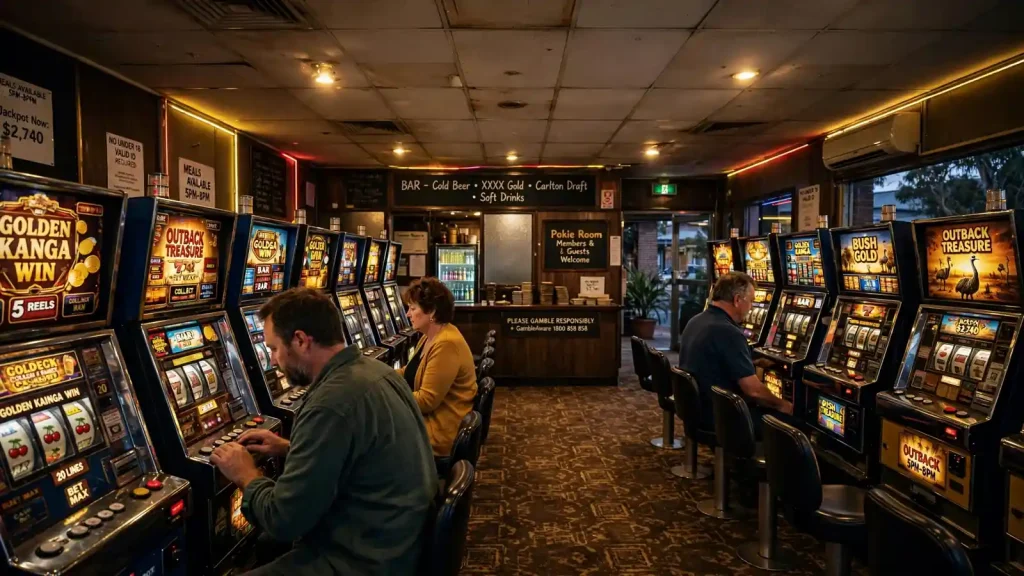
The phrase points to a physical gaming setting, while online offers and casino access raise separate questions of legitimacy and legality.
Table of Contents
- The Australian Pokie Parlour: A Physical Casino, Not a Website
- Where Casino Gambling Sits on the Australian Map
- The Machines Behind the Parlour Name
- Reading a Pokies Parlour Review Against the Record
- VIP Access and the Boundaries of Casino Entry
- Sign-Up Bonuses: What a Website Address Cannot Prove
- Free Chips and Spins in a Market of Uncertain Domains
- Online Play, Free Play and the Australian Legal Line
- When “Pokies Parlour Bonus” Is Only a Search Phrase
- Real-Money Searches and the Difference Between Access and Legitimacy
- Casino Access
The Australian Pokie Parlour: A Physical Casino, Not a Website
In Australia, “pokie parlour” sounds like a room set aside for machines: a compact, purpose-built place where the lights, screens and steady rhythms of gaming are the point. But in a casino context, the phrase is better understood as an informal description than as the name of a distinct kind of venue. It does not, by itself, identify a particular property, an official licence category or a service on the internet.
That distinction matters because the word parlour can make a casino seem smaller and more local than it is. A search for a pokie parlour may lead to a person imagining a dedicated gaming room, while the underlying subject is a physical casino operating as part of Australia’s licensed venue sector. A casino can contain gaming areas without being merely a room of machines. The label narrows the picture; the building and its regulatory setting are broader.
The adjective “physical” is doing useful work here. A parlour-style casino refers to an in-person setting, not a website that offers games under a similar name. Online pages can borrow the familiar vocabulary of land-based gaming, but the shared words do not make the services equivalent. One belongs to a real venue; the other is a digital service. The resemblance is linguistic, not proof of a common status.
Choosing a pokies parlour-style casino in Australia calls for checking the concrete details available about each option, such as its stated licence, deposit minimum or payout timing. This list offers a concise reference point for reviewing those details.
1. Playfina Casino
License: Curacao eGaming (Hollycorn N.V., since 2017) · Min. deposit: A$20-30 (depends on the offer) Playfina Casino is listed with a Curacao eGaming licence held by Hollycorn N.V. since 2017. Its minimum deposit is A$20–30, depending on the offer.
2. DragonSlots Casino
License: Curacao Gaming Authority (Jumpman Gaming Ltd) DragonSlots Casino is listed with a Curacao Gaming Authority licence associated with Jumpman Gaming Ltd.
3. LevelUp Casino
License: Curacao eGaming OGL/2023/174/0082 (Dama N.V.) · Min. deposit: A$15 LevelUp Casino is listed with Curacao eGaming licence OGL/2023/174/0082, held by Dama N.V. Its minimum deposit is A$15.
4. Bizzo Casino
License: Curacao Gaming Control Board (TechSolutions Group N.V.) Bizzo Casino is listed with a Curacao Gaming Control Board licence associated with TechSolutions Group N.V.
5. LuckyVibe
License: Curacao Gaming Control Board OGL/2023/176/0095 (Hollycorn N.V.) LuckyVibe is listed with Curacao Gaming Control Board licence OGL/2023/176/0095, held by Hollycorn N.V.
6. Thor Casino
License: Curacao – Antillephone N.V. (Versus Odds B.V.) · Min. deposit: EUR 20 Thor Casino is listed with a Curacao licence associated with Antillephone N.V. and Versus Odds B.V. Its minimum deposit is EUR 20.
7. SpinsUp
License: Curacao Gaming Control Board OGL/2023/174/0082 (Dama N.V.) SpinsUp is listed with Curacao Gaming Control Board licence OGL/2023/174/0082, held by Dama N.V.
8. SkyCrown
License: Tobique Gaming Commission · Payout speed: crypto ~10-15 minutes, fiat 1-5 days · Min. deposit: A$30 SkyCrown is listed with a Tobique Gaming Commission licence and a minimum deposit of A$30. Stated payout times are around 10–15 minutes for crypto and 1–5 days for fiat.
9. MrPacho
Payout speed: crypto 30-120 minutes, fiat 24-72 hours · Min. deposit: A$30 MrPacho has a stated minimum deposit of A$30. Payout times are listed as 30–120 minutes for crypto and 24–72 hours for fiat.
10. Golden Pokies
License: Curacao Golden Pokies is listed with a Curacao licence.
This is not a pedantic distinction. Gambling has long depended on places as much as on games: rooms where people gather, where operators control the environment, and where public rules meet private business. Australia’s casino sector makes that arrangement visible. Each casino property operates under a licence issued by its state or territory jurisdiction. The authority over a physical casino is therefore attached to a place and a local legal framework, rather than conferred by a phrase such as “pokie parlour” appearing in a name or description.
That is why the label should not be treated as a promise about what a venue contains or how it is run. “Parlour” may suggest an intimate room, but it cannot establish the layout, the range of facilities, the opening arrangements or the terms of entry. Those are matters specific to a property. The word gives a broad mental picture, not a floor plan.
The scale of the sector is also larger than the diminutive sound of the phrase suggests. A specialist review places the number of full-scale Australian casinos above twenty, across all eight states. That is a useful indication of national reach, but it is still a tally attributed to a particular kind of publication, not a permanent definition of the market. Venues and classifications can change; a count is a snapshot, not a constitutional fact.
Highest-Payout Online Casinos in Australia: RTP Explained · $1 Minimum Deposit Casinos in Australia Explained
A parlour, in the everyday sense, is often imagined as a smaller and more contained venue than a full-scale casino. The mismatch between that image and the national casino landscape says something about how people name gambling places. Familiar words compress complicated institutions into manageable shapes. A “parlour” sounds almost domestic, even when the business behind the door is part of a highly regulated industry. The language softens the architecture. The licence does not.
In the Australian setting, then, “pokie parlour casino” is best read as a description of a physical gambling environment, not as a reliable legal or commercial classification. It points toward casino gaming in a venue, while leaving the exact property and its features to be established separately. The phrase may be useful shorthand, but it cannot do the work of a location, an operator’s details or the relevant jurisdiction.
Nor does the appearance of a casino-like name online turn a website into a local casino. A digital page can use the imagery and vocabulary associated with a bricks-and-mortar venue, yet that resemblance says nothing decisive about its authorisation or its relationship to a physical property. The internet is unusually good at reproducing the signs of a place without being that place. A picture of a gaming floor is not a gaming floor.
The difference is worth keeping in view whenever the word “parlour” appears beside “casino”. In Australia, it evokes the social and physical setting of casino gambling, but it should not be mistaken for a separate kind of institution or a shortcut to judging a service. The venue is real; the label is descriptive. Plain enough.
A "pokie parlour" is a descriptive term for a physical gambling environment in Australia, rather than a specific legal or commercial classification.
Where Casino Gambling Sits on the Australian Map
Australia’s gambling map is not simply a line of major capitals. A specialist gambling guide counts gaming activity in 147 Australian cities, a figure best read as that guide’s particular inventory rather than a permanent national register. Cities enter such tallies according to what the source counts as a gambling facility; the number therefore describes a mapped snapshot, not a settled measure of the country’s social geography.
That distinction matters. A list of places with gambling does not mean that each place has the same kind of venue, or that the facilities are distributed evenly. The map is shaped by population, tourism, local economies and state and territory decisions about gambling. The resulting pattern is less a neat national grid than a series of concentrations, with smaller urban centres appearing in the same broad inventory as the largest cities.
Sydney, in New South Wales, is identified by the same kind of specialist guide as Australia’s largest gambling city, with 11 gambling facilities. The count gives a sense of concentration, not a claim that every facility is a casino or that all serve the same public. “Largest” here belongs to the guide’s way of measuring the field. It is useful as a comparison, provided the measure is kept in view.
$1 Minimum Deposit Pokies in Australia: Payment Limits · $2 Minimum Deposit Casinos in Australia: What to Know
The geography also changes when attention moves away from the east coast’s largest urban centre. In the Northern Territory, a specialist gambling listing records three casinos across three cities. It identifies Alice Springs as the city with the highest casino count there, at one. That formulation is modest, almost comically so: the leading count is still one. Yet it shows how a national map can be made from very different scales, where a single venue may define a city’s place in a regional tally.
The difference between a city count and a venue count is easy to blur. A city may appear in a gambling map because it has some form of gambling facility; a casino count is narrower. Neither number alone describes how residents use those places, how far they travel, or what role gambling plays in local life. A map can locate an industry. It cannot explain the habits that gather around it.
That is where Australia’s state and territory structure quietly enters the picture. Casino properties operate under licences issued by their own jurisdictions, so the national pattern is not the product of one central planner drawing venues across a blank map. Local rules and decisions shape what is present in each place, while the country’s distances make the difference between a capital-city cluster and a regional venue more than a matter of symbols on a page.
The broad picture, then, is one of uneven distribution and varied scale. Sydney stands out in a specialist listing; the Northern Territory’s count shows how sparse the pattern can be elsewhere. Neither snapshot should be mistaken for an eternal atlas. Gambling geography moves with institutions and places, and a count is only as durable as the boundaries used to make it.
Sydney
Identified as Australia’s largest gambling city with 11 gambling facilities.
Northern Territory
Records three casinos across three cities, with Alice Springs having the highest count at one.
National Scale
Over twenty full-scale casinos operating across all eight states.
The Machines Behind the Parlour Name
“Parlour” suggests a room organised around a particular activity: people arrive, settle in, and spend time among machines. In Australian casino settings, that image points less to a separate kind of venue than to the gaming-machine floor within a physical casino. The word carries an older, more intimate scale; the licensed casino is a larger institution, with its own rules and public life.
The national count gives the machinery a firmer outline. Australian casino venue licences endorse and have installed 3,308 gaming machines in total. That figure describes machines in casinos, not every machine in every kind of gambling venue. It also says nothing by itself about how a room is laid out, how busy it is, or what a visit feels like. A count is an inventory, not a portrait.
Still, the number matters because the parlour image is so often built from repetition: rows of individual machines, each offering a private pocket of attention inside a shared room. The scene is both solitary and social. Players face their own screens, while the venue arranges them together; the architecture turns separate acts into a collective routine.
That routine has a material basis. Machines occupy floor space, require placement and maintenance, and sit within a casino’s licensed operation. “Parlour” can make the setting sound like a small room apart from the wider institution, but the machines belong to the physical casino environment rather than to an independent category created by the name.
The distinction is modest, but useful. The parlour is an image of the room; the national figure records the installed equipment behind it. One is atmosphere. The other is a count.
$5 Minimum Deposit Pokies in Australia: What to Know · $5 Minimum Deposit Casinos in Australia: What to Check
Reading a Pokies Parlour Review Against the Record
A review of a casino can sound authoritative while saying very little. “Best atmosphere”, “excellent service” and “a must-visit” are judgments, not coordinates. They may describe one visitor’s impression, but they cannot establish where a venue is, whether a name refers to a physical property, or whether the review has kept its subject straight. The useful distinction is between opinion and a detail that can be independently checked.
Location offers a modest but solid test. Lasseters Casino, for instance, is at 93 Barrett Drive in Alice Springs, in the Northern Territory. A review that places it elsewhere has made a concrete error; one that gives the address has supplied a claim that can be compared with the venue’s own published information. That does not prove every sentence around it, but it gives the account a point of contact with the world outside its adjectives.
The same principle applies beyond the centre of Australia. Jupiters Gold Coast Casino & Hotel is on Broadbeach Island, on the Gold Coast. Country Club Casino is associated with Country Club Avenue in Prospect, within Meander Valley. These are not interchangeable settings. A useful review names the place accurately and keeps the identity of the venue attached to the location, rather than letting a broad regional label do all the work.
The address is a beginning, not a verdict. A review can be accurate about a street and still lean heavily on unsupported rankings. Words such as “largest”, “best” or “most popular” need a defined comparison and evidence behind them; without those, they are promotional-sounding conclusions. Similarly, a personal account can report an impression, but it should not quietly convert that impression into a general fact about every visitor or every visit.
Do
- Use verifiable details like physical addresses.
- Present personal impressions as opinions.
- Check the date and authorship of the review.
Don’t
- Rely on unsupported rankings like “best” or “largest”.
- Confuse a descriptive label with a venue’s legal status.
- Treat glowing adjectives as evidence of quality.
Dates and authorship matter as well. A review with no clear indication of when it was written may preserve a description that no longer reflects the venue. A named reviewer or publication makes it possible to understand whose judgment is being presented, though a byline is not proof of accuracy. The careful reader separates what the review observes, what it asserts, and what it merely praises. Three different things.
That separation is especially useful when a page calls itself a “pokies parlour” review. The phrase can imply a particular kind of place, while the named subject may be a casino property with a specific identity and address. The label alone does not settle what the review actually covers. Its details do: which venue, which location, and whether the claims stay attached to that subject.
A sound review need not be bloodless. Atmosphere and personal impressions are part of describing a place. But confidence is not evidence, and a string of glowing adjectives cannot substitute for a verifiable detail. The most dependable account gives the reader both: a clearly identified physical location, and opinions presented honestly as opinions.
VIP Access and the Boundaries of Casino Entry
“VIP” suggests a door within a door: a category of access set apart from ordinary admission. In a casino, however, the label alone says little about what that access involves. It does not establish that a particular parlour has a VIP area, that membership is available, or that any special service comes with it. Those details belong to the venue’s own published conditions, not to the word itself.
$10 Minimum Deposit Pokies in Australia
The basic threshold is less mysterious. The minimum age for casino entry is 18 across Australia, and major casinos require valid photo identification at entry. A status described as VIP does not replace those conditions. Nor does it turn admission into an entitlement: the label describes a venue’s access arrangement, if one exists, rather than suspending the rules that govern who may enter.
That distinction matters because hospitality language has a way of making boundaries sound like privileges. A reserved room, a membership category or a separate entrance may be presented as a mark of distinction; none, by itself, explains who qualifies or what is included. Without a venue’s stated terms, claims about priority, complimentary services or exclusive facilities remain claims, not facts.
There is also a difference between a casino that uses membership as an entry condition and one that offers a VIP category within a broader admissions system. The word “VIP” cannot settle that difference. It is not a licence, an age exemption or a substitute for identification.
The practical reading is modest: treat VIP as a description that needs a venue-specific explanation. The universal entry conditions are clearer than the label. At the door, status has limits.
Sign-Up Bonuses: What a Website Address Cannot Prove
A sign-up bonus is presented as a welcome: a reward attached to opening an account, sometimes described as available without an initial deposit. The language is familiar from online commerce, where an offer can make a new service feel established before much else is known about it. In gambling, however, the promise and the address displaying it are separate pieces of information. Neither turns the other into proof.
A functioning website interface or the presence of a sign-up bonus is not proof of an Australian regulatory credential.
A page can load, an account form can accept details, and a promotion can be described in polished terms. Those things show that a website is functioning in some fashion. They do not establish that it is an Australian-licensed online casino. A functioning interface is not a regulatory credential. That distinction matters especially when a bonus is made to carry the reassuring weight of a welcome from a local business.
The wording of an offer can also obscure what is being claimed. “No deposit” may sound as though there is no cost or condition attached, while “sign-up” can suggest that registration is the central step. But a headline is not a full account of an offer, still less evidence of its legal status. A bonus description cannot establish where the operator is licensed, whether that licence applies in Australia, or whether the service is authorised to provide what it advertises to people here.
There is a practical reason the address itself can be misleading. Website blocking may stop a particular domain from resolving through Australian internet providers, while a service may later appear under another address. A specialist review has reported this kind of shifting access. The change can create a peculiar illusion: a new address looks like a new fact, though it may only be a new route to the same claims. A domain that works today does not certify the service behind it.
$20 Minimum Deposit Pokies in Australia
Nor does an alternate address settle the question simply by being reachable. Accessibility describes a technical circumstance, not a licensing decision. The same is true of a site that accepts account traffic or continues to display a sign-up offer. Each may tell something about the website’s operation, but none supplies the missing regulatory proof. A new web address is still an address.
This is where promotional language can do more than advertise. A welcome bonus frames the relationship as ordinary and reciprocal: a business offers something, a customer registers, and the exchange appears routine. That familiar script can make the underlying question seem secondary. Yet a bonus is not a substitute for the status of the service, and the presence of terms, banners or account pages does not answer that question. The more confidently an offer presents itself, the more important it is not to confuse confidence with authority.
The phrase “pokies parlour” adds another layer of ambiguity. In ordinary Australian usage, a parlour points towards a physical gaming setting; a bonus attached to a web address belongs to a different kind of claim. The shared vocabulary can make the two seem continuous, as if a familiar name carried the standing of a physical venue into an online offer. It does not. A web promotion cannot borrow legitimacy from the image of a local parlour.
This is not an argument that every changing address proves wrongdoing, nor that every promotional page tells the same story. It is a narrower point: access and appearance are poor substitutes for evidence of Australian licensing. The address may change; the offer may remain; the account form may keep working. None of those observations establishes that the service is locally licensed.
Legal Risk
Real-money online casino gambling supplied to people in Australia is prohibited under the Interactive Gambling Act 2001.
Promotions are designed to make the first step feel uncomplicated. That is their purpose. But ease of entry is not a verdict on the operator, and a bonus headline cannot make one. A welcome is not a licence.
Free Chips and Spins in a Market of Uncertain Domains
Free chips and spins belong to the vocabulary of online promotions, not to a reliable description of a physical gaming venue. A page promising a free casino-style game may borrow the language of a parlour while offering something entirely different: a website whose address, operator and status need to be considered separately. The words on a banner are easy to change. The underlying facts are less pliable.
The domain itself can add another layer of confusion. Website-blocking action in Australia can affect whether a particular address resolves through an internet service provider. A page that fails to load may later appear under a different address, while an address that does load may tell nothing decisive about the service behind it. Availability is a technical condition, not a credential.
Regulatory reporting has recorded ACMA blocking action involving illegal gambling services, including alternate domains associated with Fair Go. That is a specific enforcement context, not evidence that every site using similar promotional language is connected to that service. Nor does a changed web address, by itself, explain why an older one stopped working. There may be several explanations; an advertisement rarely supplies the useful distinction.
VPN-Friendly Casinos in Australia: Access and Rules
The shifting address can make a promotion look newly available when only its route has changed. A page may retain familiar wording, graphics or claims while moving to another domain. That continuity can encourage the impression that the offer and the service have been independently verified. They have not. Repeated branding is not verification, and a browser’s ability to open a page cannot establish Australian authorisation.
“Free” also describes the pitch, not the full arrangement. The phrase may draw attention to a chip or spin while leaving the surrounding conditions elsewhere on the site. In a market where prohibited interactive gambling services are subject to enforcement, promotional language should not be mistaken for a signal that an online casino is lawful to provide in Australia. The existence of a bonus page does not change the legal character of the service it promotes.
This is where domain uncertainty matters more than the apparent generosity of an offer. A free-spin banner attached to a blocked or changing address is not made safer by being familiar, and a free-chip claim does not become official because it appears on a polished page. The visible offer can be copied; the address can be replaced; neither settles the question of who is operating the service or whether it may lawfully serve people in Australia.
A physical parlour and an online page may share a few words, but they do not share the same regulatory footing simply because the page adopts parlour imagery. In Australia, the address is a moving part of the online environment. It is not a verdict.
ACMA can request internet service providers to block access to websites that provide or advertise prohibited interactive gambling services in Australia.
Online Play, Free Play and the Australian Legal Line
The word “play” can describe very different things. In a physical gaming venue, it refers to activity on the premises. On a screen, it may mean a simulated game with no money involved, or a service through which people in Australia are offered casino-style gambling for money. The interface can look similar; the legal category does not depend on how familiar the buttons appear.
Under the Interactive Gambling Act 2001, operators must not provide real-money online casino games to people located in Australia. The prohibition covers casino-style services such as online blackjack, roulette and poker. Calling a service a parlour, a club or a free-play room does not, by itself, settle what it is. What matters is the service being provided and whether it involves real-money gambling.
“Free play” needs particular care as a description. It may refer to a game that is only a simulation, but a label alone cannot establish that no money or gambling service is involved. A real-money service does not become permissible because a page uses the word “free” or presents an introductory screen without an immediate payment. The law concerns the operator’s service to people in Australia, not merely the language used to describe it.
This distinction also keeps two questions apart: whether a website can be reached, and whether its service is lawful here. A page loading successfully, taking account traffic or appearing at another address does not make the operator an Australian-licensed online casino. Access is a technical condition, not a regulatory endorsement.
Online Casino Security in Australia: What It Means
The federal regulator responsible for enforcing the Interactive Gambling Act 2001 and monitoring compliance with federal interactive gambling rules is the Australian Communications and Media Authority, or ACMA. Where a website provides prohibited interactive gambling services in Australia, or advertises them, ACMA can ask internet service providers to block access. Blocking is one part of enforcement; it is not a declaration that every address that remains reachable has passed a licensing test.
The scale of that work is visible in ACMA’s published enforcement figures. Since November 2019, the authority has blocked more than 1,455 illegal gambling and affiliate websites after taking enforcement action. The record also describes services leaving the Australian market after enforcement began in 2017, but the reported total is not consistent: one account puts the number above 210, while another says more than 190. Those figures should not be blended into a single precise count. The disagreement is part of the record.
A physical venue and an online service therefore sit on different legal ground. Casino gambling in Australia is regulated through state and territory arrangements for licensed premises; that framework does not create permission for operators to offer online casino gambling to people in the country. Nor does an overseas licence change the federal rule for a service offered to someone physically located in Australia.
The distinction is easy to blur on a small screen, where a game’s appearance may borrow the atmosphere of a gaming floor while concealing who operates it and what kind of service is being offered. The legal line is less theatrical: real-money online casino gambling supplied to people in Australia is prohibited, and ACMA has powers to act against services and their advertising.
A screen is not a venue.
Summary of Online Gambling Rules
- Real-money online casino games are prohibited for people in Australia under the Interactive Gambling Act 2001.
- ACMA monitors compliance and has blocked over 1,455 illegal gambling and affiliate websites since November 2019.
- Technical accessibility or the use of alternate domains does not grant legal legitimacy to a service.
- A physical casino’s regulatory framework does not extend permission to online casino operators.
When “Pokies Parlour Bonus” Is Only a Search Phrase
The word “bonus” carries the promise of something added: extra value, a welcome gesture, a reason to choose one place over another. In gambling language, however, it can name several different things—or simply dress up an expectation. Paired with “pokies parlour”, it joins the vocabulary of a physical gaming room to the promotional vocabulary of websites. The phrase sounds precise; its meaning may not be.
A parlour suggests a place. A bonus suggests an inducement. Put together, they can leave the impression that a particular venue has a defined reward attached to it. That impression is not evidence of an actual offer, nor does the wording establish who is making the claim or what it applies to. Promotional language is skilled at sounding like a fact before it has supplied one.
There is a social history in that small confusion. Gambling has long been presented not only as a wager but as an occasion: a room, a machine, a night out, a reason to stay. The added promise fits neatly into that older language of hospitality. Yet a casino’s physical character and a website’s promotional claims belong to different settings, even when a phrase tries to fold them into one.
In Australia, gambling services sit within a regulatory structure, not a vocabulary. A polished page, a familiar venue name or a bonus label cannot change the nature of the service being described. Nor does a website’s accessibility, its ability to accept account traffic or its appearance at an alternate address establish that it is an Australian-licensed online casino. That distinction matters because the words used to sell an idea can travel more freely than the service itself.
The phrase may therefore be read as an expression of expectation rather than a reliable description: someone is looking for a reward associated with a parlour-style gambling experience. That interpretation says something about the market’s language, but little about whether any inducement exists, who may lawfully make it, or what conditions might attach to it. Those are separate questions, and a catchy label cannot answer them.
Pokies Open Near Me in Australia: Hours and Access
The safest reading is the least glamorous. “Bonus” is a claim to be examined, not a benefit already in hand. In a field where familiar words can blur place, promotion and permission, the label does not settle the matter. It merely names the hope.
Real-Money Searches and the Difference Between Access and Legitimacy
A site that loads is evidence of a connection, not a credential. The same is true when a page accepts account traffic or reappears at a different web address: none of these things establishes that the service is an Australian-licensed online casino. The distinction can be easy to miss because screens make reachability look official. A functioning doorway is still only a doorway.
For real-money casino play, the legal position is not a matter of how polished a site appears or how steadily it can be reached. The Interactive Gambling Act 2001 prohibits operators from providing online casino games for money to people physically in Australia. That includes casino-style games such as slots, poker, blackjack and roulette. An offshore address does not turn prohibited provision into a locally authorised service.
Casino sites not on BetStop in Australia explained
The Australian Communications and Media Authority enforces the federal rules. It can ask internet service providers to block access to websites that provide prohibited interactive gambling services or advertise them in Australia. Blocking may change which addresses resolve, while alternate domains can surface later. That shifting pattern describes access conditions; it does not certify a service. Nor does a new address amount to a new legal status.
This is a peculiarity of the digital threshold: the screen can be open while the legal door remains shut. A domain name is not a licence, and a successful connection is not regulatory approval. The distinction matters precisely because access is visible and legitimacy is not. One can be mistaken for the other with very little effort.
Casino Access

$1 Minimum Deposit Casinos in Australia Explained
The advertised threshold may reflect the casino’s cashier settings, while payment processors can impose a...

$1 Minimum Deposit Pokies in Australia: Payment Limits
An operator’s stated minimum may not match the amount a bank, wallet or processor can...

$10 Minimum Deposit Casinos in Australia: What to Know
The casino’s stated minimum may differ from a payment provider’s floor, while withdrawal rules and...

$10 Minimum Deposit Pokies in Australia
A site's stated minimum can differ from the amount a payment method will process, so...

$2 Minimum Deposit Casinos in Australia: What to Know
The advertised casino minimum is only one part of the transaction; payment limits, bonus terms...

Understanding $20 Minimum Deposits at Australian Casinos
The amount accepted depends on both the casino’s deposit settings and the minimum imposed by...
$20 Minimum Deposit Pokies in Australia
The usable minimum can depend on both the operator’s limit and the payment route, while...

$5 Minimum Deposit Casinos in Australia: What to Check
A casino’s stated minimum can differ from the payment method’s floor, so the amount needed...

$5 Minimum Deposit Pokies in Australia: What to Know
The operator’s stated minimum can differ from the amount a payment route accepts, shaping whether...

Casino sites not on BetStop in Australia explained
BetStop status, Australian licensing rules and offshore access are separate issues, and account availability does...

Curaçao Casino Licences for Australian Players
The guide separates operator obligations under Australian law from the legal position of individuals using...

Highest-Payout Online Casinos in Australia: RTP Explained
Slot RTP describes a game’s theoretical return over extended play, not an individual result or...

Low Deposit Online Casinos in Australia: What to Know
Payment limits, bonus conditions and withdrawal thresholds can affect how useful a small starting balance...

Online Casino Security in Australia: What It Means
Technical safeguards, operator legality and payment routes are separate questions when assessing offshore real-money casino...
No-minimum-deposit casinos in Australia: what it means
An operator may set no deposit floor, while a bank or payment service still limits...

Pokies Open Near Me in Australia: Hours and Access
Australian casino hours vary by venue and holiday, and a listed opening time does not...
Safe Online Casinos in Australia: What the Law Says
Online casino games cannot lawfully be offered to people in Australia, so payment security and...

VPN-Friendly Casinos in Australia: Access and Rules
A VPN can alter the connection route and apparent IP location, but it does not...



































































































































































































