
Casinos That Accept Visa in Australia: What to Know
 Available in AU
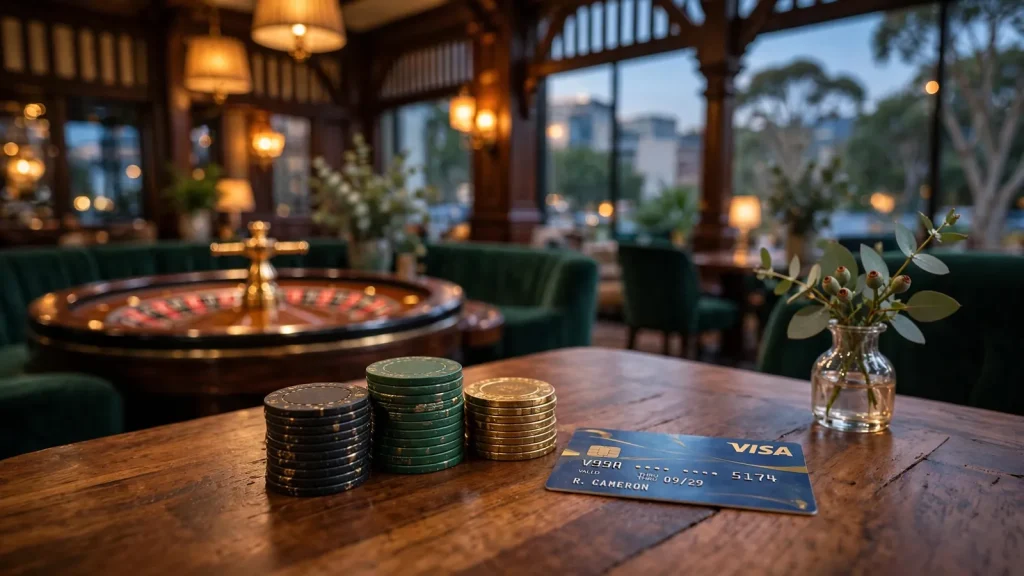
Visa availability does not establish that an offshore casino may lawfully offer real-money games to people in Australia.
Table of Contents
Where Visa Fits in Australia’s Casino Payment Landscape
Visa has a recognisable place in conversations about payment choice, but its presence on a card does not settle whether a particular online service can lawfully take that card. A specialist review has described Visa as potentially more widely accepted by Australian-facing online casinos than American Express. That is a limited comparison, not a guarantee of acceptance across services, and it says nothing about whether the underlying gambling service is permitted in Australia.
That distinction matters here. The Interactive Gambling Act 2001 makes it illegal for operators to provide real-money online casino games to people physically located in Australia. The prohibition covers casino-style games such as poker, blackjack, roulette and pokies. A payment brand may be familiar, and a website may present a polished cashier, but neither fact changes the legal position of the service being offered.
The payment landscape and the gambling landscape are not the same thing. One describes the ordinary ways people pay; the other determines what operators may offer. Confusing them can make a familiar card logo seem like evidence of legitimacy. It is not.
Use this list as a starting point when researching casinos for Visa payments in Australia. The details provided do not confirm Visa availability, so check the payment options directly before depositing.
1. Playfina Casino
License: Curacao eGaming (Hollycorn N.V., since 2017) · Min. deposit: A$20-30 (depends on the offer) Playfina Casino is listed with a Curacao eGaming license held by Hollycorn N.V. since 2017. Its minimum deposit is A$20–30, depending on the offer.
2. DragonSlots Casino
License: Curacao Gaming Authority (Jumpman Gaming Ltd) DragonSlots Casino is listed with a Curacao Gaming Authority license held by Jumpman Gaming Ltd.
3. LevelUp Casino
License: Curacao eGaming OGL/2023/174/0082 (Dama N.V.) · Min. deposit: A$15 LevelUp Casino is listed with Curacao eGaming license OGL/2023/174/0082, held by Dama N.V. Its minimum deposit is A$15.
4. Bizzo Casino
License: Curacao Gaming Control Board (TechSolutions Group N.V.) Bizzo Casino is listed with a Curacao Gaming Control Board license held by TechSolutions Group N.V.
5. LuckyVibe
License: Curacao Gaming Control Board OGL/2023/176/0095 (Hollycorn N.V.) LuckyVibe is listed with Curacao Gaming Control Board license OGL/2023/176/0095, held by Hollycorn N.V.
6. Thor Casino
License: Curacao – Antillephone N.V. (Versus Odds B.V.) · Min. deposit: EUR 20 Thor Casino is listed with a Curacao license held by Antillephone N.V. for Versus Odds B.V. Its minimum deposit is EUR 20.
7. SpinsUp
License: Curacao Gaming Control Board OGL/2023/174/0082 (Dama N.V.) SpinsUp is listed with Curacao Gaming Control Board license OGL/2023/174/0082, held by Dama N.V.
8. SkyCrown
License: Tobique Gaming Commission · Payout speed: crypto ~10-15 minutes, fiat 1-5 days · Min. deposit: A$30 SkyCrown is listed with a Tobique Gaming Commission license and a minimum deposit of A$30. The stated payout speed is around 10–15 minutes for crypto and 1–5 days for fiat.
9. MrPacho
Payout speed: crypto 30-120 minutes, fiat 24-72 hours · Min. deposit: A$30 MrPacho has a stated minimum deposit of A$30. Its stated payout speed is 30–120 minutes for crypto and 24–72 hours for fiat.
10. Golden Pokies
License: Curacao Golden Pokies is listed with a Curacao license.
A familiar card in a different setting
Across Australia, contactless credit and debit card payments are accepted almost everywhere. Mobile wallets, including Google Pay and Apple Pay, are similarly common. That everyday visibility helps explain why Visa can appear an obvious candidate when people think about online payments. Cards sit in wallets; mobile wallets sit on phones; paying by tapping has become an unremarkable part of daily commerce.
But daily commerce is not a useful shortcut for judging online gambling. A card accepted at shops or other lawful businesses does not thereby become a permitted way to fund a prohibited casino service. Nor does the broad availability of contactless payments establish that a particular online gambling operator can accept Visa. The ordinary reach of a payment system is one matter. The legal conditions around its use are another.
Australian consumers are also comfortable moving between cards, mobile wallets and services linked to bank accounts, such as PayPal. That flexibility reflects a payment culture in which convenience is often built around the transaction rather than loyalty to one instrument. Yet a range of familiar payment options does not make every service behind a checkout lawful. A wallet can make a transaction feel routine while leaving the nature of the service unchanged.
The distinction is especially important because “Visa” can refer to a payment network appearing on different kinds of cards. Credit and debit are not interchangeable categories in the law or in payment handling. Online gambling services must not accept credit card payments. A Visa logo, without further detail, does not establish which kind of card is involved, what transaction is being attempted, or whether the service itself may lawfully be offered.
Casinos that accept POLi in Australia: what to know · Casino sites that accept Osko in Australia: key facts
This is why claims about an “Australian online casino that accepts Visa” need more than a card logo to be meaningful. The wording may describe a cashier interface, a payment option shown to some account holders, or a claim made by a site operating from offshore. None of those descriptions answers the legal question. The service remains subject to the Australian prohibition when it offers real-money online casino games to people in Australia.
Acceptance is not permission
A payment method can be widely recognised without being a safe route into every service that displays it. That is not a peculiarity of Visa. It is a basic difference between the infrastructure that moves money and the rules governing what businesses may sell. Payment networks, banks, wallets and operators each occupy different positions in a transaction; the presence of one does not certify the conduct of the others.
The Australian legal framework places the obligation on operators not to provide prohibited online casino services to people physically in the country. The Australian Communications and Media Authority is responsible for enforcing the Interactive Gambling Act 2001. The law does not explicitly criminalise players for using offshore sites, but that absence of player criminal liability is not an endorsement, nor does it turn an offshore service into a lawful local casino.
There is another practical difference: Australian consumer law does not protect people who use offshore casinos. The familiar appearance of a payment page cannot supply those protections. A Visa mark does not make an offshore operator subject to the same consumer safeguards as a lawful Australian business, and a site’s willingness to display payment options does not guarantee that a dispute will have a local remedy.
Legal Risk
Providing real-money online casino games to people physically located in Australia is illegal under the Interactive Gambling Act 2001.
This is the quiet danger in treating acceptance as a seal of approval. Payment systems are designed to make transactions legible and efficient. Their logos have become shorthand for familiarity. But a card brand is not a regulator, and a cashier is not a licence. In this market, that difference is more than technical.
The restriction is not confined to a particular game or a particular style of website. Online casino-style games, including pokies and table games, are treated as prohibited interactive gambling services when supplied to customers in Australia. A site’s location overseas does not change the fact that the service is being offered to someone physically in Australia. Nor does a payment route alter the classification of the game.
What a Visa claim can and cannot say
The specialist-review comparison between Visa and Amex is best understood narrowly: it suggests Visa may have broader reported acceptance in this category than Amex. It does not establish a universal market rule, and it should not be read as a current directory of services. Online payment arrangements can differ between operators and may change. A general comparison cannot determine what a given site currently displays or accepts.
More importantly, a statement about card acceptance is not a statement that an operator may lawfully offer online casino games in Australia. The distinction should remain clear even when a search phrase joins “Visa” with “Australian pokies” or “online casino.” The phrase captures a payment preference, not an exception to the law.
PayID Casinos in Australia: What Is Verified · Casinos That Accept CashtoCode in Australia: Key Checks
There is no meaningful “best” Visa casino to identify within this legal frame. Ranking or recommending offshore casino services would risk turning a payment discussion into promotion of services that Australian operators are prohibited from offering to people here. Familiarity, convenience or a payment logo cannot make such a recommendation appropriate. The useful point is more restrained: Visa may be reported as more broadly accepted than Amex, but acceptance does not establish legality or consumer protection.
That restraint can feel unsatisfying in a world trained to expect every payment question to end with a shortlist. But the distinction is a real one, not a footnote. When the product itself is prohibited for operators to supply locally, comparing its checkout options can obscure the larger fact. The law comes before the cashier.
A further complication is that a customer may see payment language that sounds definitive while leaving essential context unstated. “Visa accepted” does not, by itself, tell whether the statement applies to credit or debit cards, whether it relates to a service accessible from Australia, or whether the service is lawfully offered here. These are separate questions, and the logo answers none of them on its own.
That does not make Visa an unusual or suspect payment brand. It is part of everyday Australian payment life. The point is that everyday recognition can travel farther than the protections attached to a transaction. A familiar card may sit at the border between ordinary commerce and an offshore gambling service, but familiarity is not a legal bridge.
Key Legal Points
- The Interactive Gambling Act 2001 prohibits operators from providing online casino games to people in Australia.
- Card logos do not certify the legality or regulatory approval of a gambling service.
- Australian consumer law does not protect users of offshore casinos.
- The ACMA is responsible for enforcing gambling prohibitions.
The wider payment culture
The broader Australian pattern is one of choice. Cards, mobile wallets and bank-linked services coexist, and people are accustomed to switching among them. That flexibility has been shaped by the spread of contactless payments and digital wallets into routine transactions. It can make online checkouts feel like a simple extension of shopping, bill-paying or transferring money.
Online gambling presents a different question because the legal framework is directed at the service, not merely the method used to pay for it. The Interactive Gambling Act 2001 prohibits operators from providing real-money online casino games to people in Australia. Whether a service is presented through a website, an app or a cashier page does not change that rule. Neither does the payment instrument.
The same distinction prevents a misleading inference from the broad availability of cards in the country. Widespread acceptance in ordinary Australian commerce tells little about whether Visa can or should be used with an offshore casino. The general fact concerns payment habits. The specific question concerns a prohibited service and the legal protections available to its customers.
This separation can be easy to miss because payment technology is designed to recede from view. A tap, a saved card or a wallet button removes friction. In a lawful setting, that can be useful. In a prohibited gambling setting, frictionlessness should not be confused with legitimacy. A smooth checkout is a design feature, not a verdict.
Australia’s approach also reflects a wider choice about responsibility. The law places its prohibition on operators supplying online casino games to people in the country, while not explicitly making players criminally liable for using offshore sites. That is not the same as treating the activity as protected or safe. Consumer law does not protect people who use offshore casinos, and the enforcement role belongs to the Australian Communications and Media Authority.
Casino Sites That Accept Amex in Australia
The gap between operator prohibition and player exposure is consequential. A person may not face criminal liability simply for using an offshore site, yet still be outside Australian consumer protections when dealing with it. The operator’s availability, the card’s recognition and the absence of player criminal liability can each create a misleading sense of normality. None supplies the protections that are absent.
A payment option can therefore be described accurately only with care. Visa may be reported as more broadly accepted than Amex at Australian-facing online casinos, according to a specialist review. That observation remains about reported reach. It is not an invitation to use such a service, an endorsement of its operators or proof that Australian law permits the activity.
The commonplace card has a complicated public life. It can signify convenience in the supermarket queue and, elsewhere, appear as a small badge on a gambling website. The visual symbol stays constant; the legal setting does not. That is the point worth keeping in view when Visa is discussed alongside Australian online casinos. Familiarity travels. Protection does not.
Visa Deposits, Payment Choices and the Limits of the Evidence
A Visa logo on a payment page can look like a simple answer to a practical question. It is not. A payment brand does not establish that a particular online gambling service may lawfully accept a card from someone in Australia, nor does it establish which kind of card the logo refers to. Credit and debit cards share familiar branding, but the distinction matters: online gambling services must not accept credit card payments.
Credit Card Prohibition
Online gambling services must not accept credit card payments, regardless of the payment network logo displayed.
That rule changes the meaning of a search for a Visa deposit. In an ordinary shop, a card logo signals a way to pay. In the context of online casino gambling offered to people in Australia, it cannot be treated as an invitation or assurance that a payment will be accepted. The Interactive Gambling Act 2001 prohibits operators from providing real-money online casino games to people physically located in Australia. The prohibition covers online casino-style services, not merely a particular way of funding them. A payment method does not make the underlying service lawful.
What a card label can—and cannot—tell us
The term “Visa” alone does not say whether a transaction would be processed as credit or debit. Nor does a logo on a page establish that a transaction is available to an Australian customer, permitted by the law, or supported by the card issuer. Each of those questions belongs to a different part of the arrangement: the card, the payment provider, the operator and the law.
That distinction can be obscured by the tidy language of online cashiers. A menu of payment marks presents the appearance of choice, as if each symbol were a neutral door into a service. But a displayed option is not a legal safeguard, and the presence of a familiar financial brand is not an endorsement of the activity on the other side of the page. Payment infrastructure can be international; the rules governing gambling services are not thereby erased.
Visa itself is not a casino licence, a regulator or a guarantee of consumer protection. It is a payment brand. Treating its appearance as approval of an online casino would confuse the plumbing with the building. The distinction is especially important in Australia, where the law places the prohibition on operators providing these services to people in the country.
Casinos That Accept Neosurf in Australia: What to Check · Google Pay at Australian Casinos: What the Evidence Shows
The same caution applies to claims about a particular deposit amount. A sum entered into a cashier is not a standard set by Visa or by Australian payment practice. The amount, if a transaction is even offered, would be a matter of the service’s own payment arrangements and the applicable rules. A specific figure cannot responsibly be presented as a general Visa deposit threshold for Australians.
Nor does a card label establish how quickly a payment would be processed. Payment timing is not a property that can be read from the word “Visa” alone. It would depend on the transaction and the parties handling it, and no universal processing promise follows from the brand.
A similar boundary applies to game-specific payments. The appearance of a card option does not show that the same payment route applies to every game or gambling product, and it does not establish that any such product may lawfully be offered in Australia. Naming individual games alongside a payment method can quietly imply a service is available, even where the legal framework says otherwise. That implication should be avoided.
Bonuses create another misleading association. A payment method does not, by itself, establish that a promotion is available, what its terms are, or whether a particular payment qualifies. Promotions are not neutral decoration: Australian restrictions on advertising interactive gambling services also constrain how inducements and promotions may be presented. A payment mark cannot be used as a back door to advertise a prohibited gambling service.
Do
- Distinguish between credit and debit card categories
- Recognise that payment logos are not regulatory licences
- Prioritize legal status over cashier convenience
Don’t
- Treat a Visa logo as evidence of legitimacy
- Assume offshore services offer Australian consumer protections
- Confuse smooth payment design with legal permission
The small-print world of payments tends to make every choice look technical. The legal question is less technical. Operators must not provide real-money online casino games to people physically located in Australia. A cashier interface, a card network or a bonus banner cannot alter that position.
The ordinary payment habit, and the unusual setting
Australians are accustomed to moving between cards, mobile wallets and services connected to bank accounts. Contactless card payments and mobile wallets are part of everyday commerce across much of the country. That familiarity can make a card-branded cashier seem like a continuation of ordinary shopping. It is not an ordinary shop.
In retail, a payment choice normally sits within a lawful sale. In the offshore casino context, the same familiar symbols appear alongside a service that Australian law prohibits operators from supplying to residents. Convenience, where it exists, is not the same thing as legitimacy. A polished payment screen may be designed to reduce hesitation; the legal framework remains outside its frame.
This is one reason not to read a “Visa accepted” claim as a complete description. It can leave unanswered whether the card is credit or debit, whether the issuer permits the transaction, whether a payment is actually available to someone in Australia, and whether the service itself can lawfully be offered. Those are not minor details. Together, they determine what the claim means.
Credit card payments for online gambling services must not be accepted. That restriction is not transformed into a recommendation to find a debit-card route. The point is not to steer around a payment restriction, but to distinguish payment mechanics from the legal status of the gambling service. A debit card logo does not answer that separate question either.
Casinos That Accept Mastercard in Australia · Bitcoin Casinos in Australia: Legal and Payment Guide
The underlying law is also not a declaration that the player is being invited to use an offshore casino. The Interactive Gambling Act 2001 makes it illegal for operators to provide prohibited online casino services to people in Australia. The Australian Communications and Media Authority is responsible for enforcing that Act. These facts describe the market’s legal frame; they do not turn an offshore cashier into a lawful local service.
Identity checks are part of the financial process
Where online casinos conduct financial transactions, they commonly require customers to undergo identity checks, often described as Know Your Customer procedures. These checks are intended to establish who is using an account before money-related activity proceeds. They do not certify that the gambling service is lawful in Australia, and completing such a check should not be mistaken for regulatory approval.
The distinction is worth keeping plain. An operator’s request for identity documents is a procedure conducted by that operator. It is not the same as an Australian regulator authorising the operator to provide online casino games to people in the country. Formal-looking verification can create a sense of institutional order, but paperwork does not change the legal character of the service.
Payment language often concentrates attention on the immediate transaction: which symbol appears, what the cashier asks for, and whether a payment screen advances. The broader question is who is offering the service and whether that offer is allowed. In Australia, a successful card transaction would not resolve that question in the operator’s favour.
Identity Verification
KYC (Know Your Customer) procedures are operator-led identity checks and do not constitute regulatory approval or authorization from Australian authorities.
There is also a consumer consequence. Australian consumer law does not protect people who use offshore casinos. That matters because payment disputes, account terms and a platform’s own procedures are not substitutes for the protections available in a lawful domestic transaction. A familiar card brand may make the transaction feel close to home. The consumer protections may not be.
Payment method is not endorsement
Searches for casinos accepting Visa deposits often compress several different questions into one. They ask whether a card can be used, whether a particular amount will be accepted, whether the payment will arrive promptly, whether it can be used alongside a particular game, and whether a bonus is attached. Those are separate matters, and a single logo cannot answer them all.
For Australian residents, the more fundamental distinction comes first: the law prohibits operators from providing real-money online casino games to people physically located in Australia. Against that background, details such as a supposed minimum deposit or a promised processing time should not be treated as settled market facts. They are not inherent features of Visa, and presenting them as general Australian conditions would lend false certainty to an unlawful service.
The same restraint applies to offers framed around a deposit. A promotion tied to a payment method could suggest that the service is being actively marketed to Australians. Real-money interactive gambling advertising, including online casino advertising, is restricted in Australia. A payment method cannot make such an inducement neutral, and a disclaimer cannot turn a promotion into a mere description.
Casinos That Accept Litecoin in Australia: Legal Context
There is a cultural pattern here, too. Modern payment systems are designed to make spending feel routine: the card is already in a wallet, a phone can stand in for it, and the transaction is presented as a small administrative step. The law draws a boundary that the interface may not display. That boundary is easy to miss precisely because the payment ritual feels so ordinary.
A responsible account of Visa and online casino deposits in Australia therefore has to resist the cashier’s own framing. Card acceptance is not proof of legality. A payment amount or speed cannot be inferred from the brand. A payment option does not establish access to a particular game or a bonus, and it does not amount to an endorsement by Visa or an Australian authority.
The practical meaning is stark: payment symbols describe a route for transactions, not permission to provide prohibited gambling services. No logo can do that work.
Visa Withdrawals in the Offshore Gambling Context
A request for an instant Visa withdrawal sounds like a question about payment speed. In Australia, it is also a question about what kind of service is being offered, and whether that service may lawfully offer online casino games to people in the country. The payment label cannot settle either question.
Visa is a card network, not a promise that money can be sent back to a card after gambling. A Visa logo, or the appearance of Visa in a payment menu, does not establish that withdrawals are available through that route. Nor does it establish how long a transfer would take. Those details cannot be assumed from the brand name or from the fact that Visa cards are familiar in everyday Australian commerce.
Why ‘Instant’ withdrawals are not guaranteed
A Visa logo does not establish that withdrawals are available or how long they take. Processing times depend on the operator and financial parties, and the card brand itself cannot guarantee a specific speed.
The distinction matters because deposits and withdrawals are not two halves of a guaranteed transaction. A site might display a way to pay without that showing how winnings could be returned. But in the Australian online casino context, the more fundamental issue comes first: the Interactive Gambling Act 2001 bars operators from providing online casino games to people located in Australia. That includes casino-style games such as poker, roulette, blackjack and pokies. The law is directed at the operator’s conduct; it does not explicitly make an individual player’s use of an offshore site a criminal offence.
That difference should not be mistaken for consumer protection. Australian consumer law does not protect people using offshore casinos. If a payment is delayed, disputed or never arrives, a player dealing with an operator outside the country cannot assume that Australian consumer protections will resolve the problem. The legal position is not a seal of safety around offshore services. It is a boundary around what operators may provide here.
Casinos That Accept MiFinity in Australia: The Evidence
The Australian Communications and Media Authority, known as ACMA, oversees enforcement of the Act. Its role sits alongside the prohibition on operators, rather than turning offshore casino payments into a locally protected service. Offshore sites may be subject to blocking and enforcement measures. A page that remains visible, or a payment option that can be seen, does not make the underlying service lawful to offer to Australians.
There is another important distinction between credit and debit cards. Online gambling services must not accept credit card payments. A Visa credit card therefore cannot be treated as an available route for online casino gambling in Australia. The Visa name also appears on debit cards, but that does not change the legal status of an online casino service offered to Australian residents. A card type cannot make a prohibited service permissible.
This is why claims about an “instant Visa withdrawal” deserve more than a glance at a logo or a headline. “Instant” is a strong promise about the arrival of funds, while the card network alone does not establish whether a particular casino offers withdrawals to Visa or how quickly it processes them. Without an established withdrawal route, there is no meaningful speed claim to rely on. The wording can sound precise while leaving the essential question unanswered.
Casinos That Accept Apple Pay in Australia: What to Know
The same caution applies to offers framed around new casinos, real-money play or a no-deposit bonus. These phrases can make a payment method appear to be the main consideration, when the law and the absence of Australian consumer protection are more consequential. A bonus is not evidence that a withdrawal method works, and a listed payment method is not evidence that winnings can be returned through it. In Australia, promoting real-money online casino services is itself restricted; such offers should not be mistaken for ordinary consumer deals.
The word “instant” also compresses several different events into one. A payment might be shown as approved on one screen without that demonstrating when funds reach a card account. A withdrawal could be described as processed without proving that it has arrived. Those are distinct claims, and the Visa name does not collapse them into a single guaranteed outcome. In this setting, the uncertainty is not a minor technical footnote. It is part of the transaction’s basic character.
Casino Sites That Accept BPAY in Australia: What to Check
Australia’s approach reflects a choice about who should bear the risk. The Act places the prohibition on operators who provide online casino games to people in the country. The player is not explicitly criminalised merely for using an offshore site, but that does not shift the operator into a position of Australian accountability or extend local consumer protections to the customer. Permission for a player and protection for a player are different things.
So the phrase “Visa withdrawal” cannot, by itself, establish that an Australian player can receive casino winnings through Visa, still less that the transfer would be instant. The legal setting is restrictive, credit card payments are not permitted for online gambling services, and offshore casino users lack the protection of Australian consumer law. In this market, the payment promise is the smallest part of the question.
What are the deposit and withdrawal limits at the best Amex casinos?
Limits are set by each casino and can vary. Check the casino’s cashier for the limits that apply to Amex deposits and withdrawals.
Which online casinos accept American Express for deposits?
Jackpot City Casino, Spin Palace, Ruby Fortune, Ignition Casino, Joe Fortune and PlayAmo are listed as accepting Amex deposits for Australian players.
What are the fees involved with American Express payments?
Amex deposits typically have no fee, but a casino may add a 1.5% surcharge, and currency conversion can incur a 3% fee. Withdrawal fees may also apply.
Can I withdraw winnings directly to my American Express card?
Some casinos do not allow withdrawals to Amex, and withdrawals generally require that you previously deposited with Amex. Where available, a withdrawal may take up to five days to clear and may carry a fee.
Are there any fees associated with using American Express at online casinos?
Deposits are typically free, but a casino may charge a 1.5% surcharge, currency conversion may cost 3%, and withdrawal fees may apply.
What should I do if my American Express deposit is declined?
Check whether Amex or your Australian bank is blocking gambling-related payments to that website. Amex may block payments to particular sites, and banks may block gambling transactions at the issuer level.
True Blue Casino Payments in AUD: Deposits, Cards and Bitcoin

True Blue Casino Withdrawals: Methods, KYC and Cashout Checks
True Blue Casino Australia Guide Current answer: True Blue Casino withdrawals are supported through Bitcoin...

Anonymous Crypto Casinos in Australia: Payments & Risk
Bitcoin addresses are pseudonymous, while account checks and operator processing can still shape privacy and...

Aussie Crypto Casinos: Rules, Risks and Verification
Crypto payments do not confer Australian licensing; this guide examines offshore rules, verification limits, bonuses,...

Online casino payment methods for Aussie players
Payment routes can involve a bank account, a wallet and a processing provider, so the...

Casino Sites That Accept Amex in Australia
Amex availability depends on the operator and location, and a payment option being listed does...

Casino Sites That Accept BPAY in Australia: What to Check
The article distinguishes advertised deposits from confirmed payment access, withdrawal routes, operator status and game...
Casino Sites That Accept Credit Cards in Australia
Card acceptance does not determine whether an offshore casino may offer real-money games to people...

EcoPayz Casino Sites in Australia: What to Know
Australian online gambling rules, EcoPayz acceptance claims and withdrawal conditions are distinct questions that require...

Casino sites that accept Osko in Australia: key facts
The article examines Osko deposit and withdrawal claims alongside Australia's prohibition on real-money online casino...

Paysafecard Casino Sites in Australia: Key Facts
A Paysafecard mention does not confirm a deposit or withdrawal route, and Australian law shapes...

Skrill Casino Sites in Australia: What to Verify
Skrill availability, withdrawal speed and casino games are separate questions, and the available details do...

Trustly Casinos in Australia: What Can Be Verified
It examines the legal boundary for offshore casino services and why available information does not...

Under an Hour Casino Withdrawals in Australia
A withdrawal’s timing depends on operator approval as well as the transfer from approval to...
Casinos That Accept Apple Pay in Australia: What to Know
Apple Pay is common for everyday contactless payments in Australia, but that does not establish...

Bitcoin Casinos in Australia: Legal and Payment Guide
Bitcoin affects how funds move, but the operator’s location and status determine how an online...

Bitcoin Cash Casinos in Australia: Legal Checks
Payment options do not establish that a casino is verified or change the Australian rules...
Casinos That Accept CashtoCode in Australia: Key Checks
CashtoCode availability alone cannot establish an operator’s status, withdrawal support or bonus eligibility in Australia....

Ethereum Casinos in Australia: Understanding ETH Acceptance
Ethereum identifies a payment method, not a type of casino, and does not establish an...

Google Pay at Australian Casinos: What the Evidence Shows
Google Pay is a wallet, not proof that an online casino may lawfully offer real-money...
Casinos That Accept Litecoin in Australia: Legal Context
A cashier listing Litecoin does not establish that an offshore casino is authorised to offer...

Casinos That Accept Mastercard in Australia
Card availability depends on the operator and payment route, while deposit access does not establish...

Casinos That Accept MiFinity in Australia: The Evidence
A careful look at payment claims, withdrawal details and the legal limits affecting offshore online...

Casinos That Accept Neosurf in Australia: What to Check
A search result alone cannot verify that a casino accepts Neosurf, serves people in Australia,...

Casinos That Accept Neteller in Australia: Legal Context
The Act covers online casino games regardless of an operator’s location or whether an account...

PayID Casinos in Australia: What Is Verified
The available evidence covers an American Express deposit process, not a verified list of Australian...

Casinos That Accept PayPal in Australia: What to Check
An evidence-led look at PayPal claims, withdrawal checks and the difference between offshore availability and...

Casinos that accept POLi in Australia: what to know
The Interactive Gambling Act 2001 prohibits operators from offering online casino games to people in...

Casinos That Accept Tether USDT in Australia
The guide distinguishes crypto transaction features and casino acceptance claims from the separate question of...

Easy Withdrawal Casinos in Australia: Payout Timing
A clear look at operator approval, payment-network timing, identity checks and the conditions that can...

Fast Withdrawal Casinos in Australia: Approval Times
A withdrawal may move quickly after release, while operator checks and the payment route shape...

Instant Bank Transfers at Australian Casinos: PayID
PayID is bank-linked, but sending a transfer and having it credited are separate steps, within...

Instant PayID Withdrawals in Australia: Timing Explained
PayID’s near-real-time transfer starts only after operator approval, while identity checks, eligibility and banking processes...

Instant PayID Casino Withdrawals in Australia
PayID can move released funds quickly, but operator checks and Australian legal restrictions remain separate...

PayID Pokies in Australia: How Payments Work
PayID uses a phone number or email address to route bank transfers, but it is...

No-Verification Withdrawal Casinos in Australia
A practical look at deferred identity checks, payment timing, bonus wagering gates and the limits...

No KYC Casinos in Australia: What to Expect
A practical look at identity checks, crypto and other payment routes, withdrawal timing, and the...

Online pokies instant withdrawals in Australia
Withdrawal speed depends on operator review, approval and payment processing, so an instant transfer does...

Online pokies with PayID in Australia: payment guide
A practical look at PayID deposits, bank limits, account-name checks, withdrawal conditions and the legal...

Pay by Phone Casinos in Australia: Payment Guide
Carrier billing charges a mobile account, while PayID sends money through a bank account—even when...

Quick Casino Withdrawals in Australia: Payment Routes
Cashout timing depends on casino processing, the receiving service, verification, bonus terms and the original...

Same-Day Payout Casinos in Australia: How Timing Works
A practical look at the approval and transfer stages behind payout claims, the routes funds...

Solana casino comparison in Australia: key checks
SOL can be legally transferred in Australia, while offshore online casino services remain prohibited under...



































































































































































































